Marvel Rivals Rank Calculator: The Win Rate You Actually Need Is Never 50%
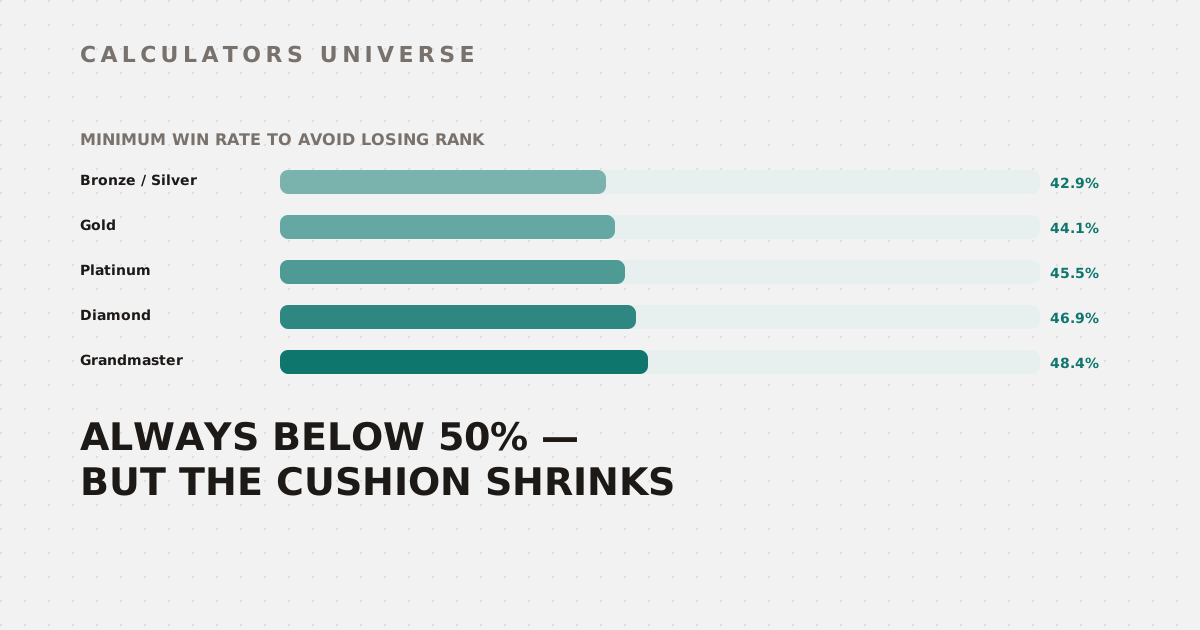
Every rank tier in Marvel Rivals has a break-even win rate under 50% — but it climbs from 42.9% in Bronze to 48.4% in Grandmaster. Here's the exact math, and where the calculator's estimate can drift.
Marvel Rivals Rank Calculator: The Win Rate You Actually Need Is Never 50%
Every rank tier in Marvel Rivals has a win rate below which you’ll actually lose ground — and it is never 50%. In Bronze or Silver, winning just 42.9% of your games is enough to slowly climb, because a win pays 20 RR against a fixed 15 RR loss. By Grandmaster, that cushion shrinks to 48.4% — barely above a coin flip — because the win reward drops to 16 RR while the loss penalty never changes. The Marvel Rivals Rank Calculator builds directly on this asymmetry, and understanding exactly where it comes from also reveals a real gap in what a single projection can tell you about a long climb.
How RR Actually Moves
Marvel Rivals’ Rank Rating system is simple on the surface: six tiers (Bronze through Grandmaster), each split into three 100-RR divisions, for 1,800 total RR from Bronze III to the top of Grandmaster I. What’s not obvious from the UI is that losses are a flat, unchanging −15 RR at every single tier, while win rewards quietly shrink as you climb:
| Tier | RR per win | RR per loss | Net RR at 50% win rate |
|---|---|---|---|
| Bronze | +20 | −15 | +2.5 |
| Silver | +20 | −15 | +2.5 |
| Gold | +19 | −15 | +2.0 |
| Platinum | +18 | −15 | +1.5 |
| Diamond | +17 | −15 | +1.0 |
| Grandmaster | +16 | −15 | +0.5 |
At exactly 50% win rate, every tier still nets positive RR — but the margin shrinks from +2.5 RR per game in Bronze down to a bare +0.5 RR in Grandmaster, a 5x difference in climb speed for identical play.
The Real Break-Even Point, By Tier
The number that actually matters isn’t the net RR at 50% — it’s the minimum win rate where net RR crosses zero at all. Solving for that threshold at each tier produces a number that’s always under 50%, but by a shrinking margin:
| Tier | Break-even win rate |
|---|---|
| Bronze / Silver | 42.9% |
| Gold | 44.1% |
| Platinum | 45.5% |
| Diamond | 46.9% |
| Grandmaster | 48.4% |
That means a genuinely losing record — winning well under half your games — still climbs you through Bronze and Silver. By Grandmaster, you need to be right at the edge of a winning record just to hold your position, let alone climb further.
Where the Calculator’s Estimate Can Drift on a Long Climb
Here’s the part that isn’t obvious from using the tool directly: the games-needed projection locks in the RR-per-win and RR-per-loss values for your starting tier, and applies that same rate across the entire distance to your target — even if your target sits in a completely different, higher tier.
That’s exact for a climb that stays within one tier. It understates the real grind for a climb that crosses tier boundaries, because the actual RR gain shrinks at each boundary the flat estimate doesn’t know about. Take a climb from Gold III (600 RR) to Grandmaster III (1,600 RR) at a 52% win rate:
| Approach | Games needed |
|---|---|
| Flat estimate (Gold-tier rate applied to the full 1,000 RR gap) | 374 games |
| Accurate, re-tiered at each boundary | 524 games |
| Segment | RR span | Net RR/game at 52% | Games |
|---|---|---|---|
| Gold (600→900) | 300 | 2.68 | 112 |
| Platinum (900→1,200) | 300 | 2.16 | 139 |
| Diamond (1,200→1,500) | 300 | 1.64 | 183 |
| Grandmaster (1,500→1,600) | 100 | 1.12 | 90 |
The flat single-tier estimate undershoots the real total by 28.6% — 374 games versus a realistic 524. The fix: for any target more than one tier above your current rank, re-run the calculator once you actually reach each new tier, using your current RR and the same win rate, rather than trusting one projection to hold across the whole climb.
Placement Matches Don’t Scale Linearly Either
Season 4’s 10-game placement system maps win count to a starting rank, and that mapping isn’t a smooth, evenly-spaced curve — three specific win thresholds each vault a player past an entire division that the surrounding results have to grind through normally:
| Wins | Placement rank | RR |
|---|---|---|
| 5 | Silver II | 400 |
| 6 | Gold III | 600 |
| 7 | Gold II | 700 |
| 8 | Platinum III | 900 |
| 9 | Platinum II | 1,000 |
| 10 | Diamond III | 1,200 |
Going 5 wins to 6 wins jumps 200 RR, not the 100 RR every other single-win step grants — skipping Silver I outright. The same 200 RR jump happens again from 7 to 8 wins (skipping Gold I) and from 9 to 10 wins (skipping Platinum I). One extra placement win, at exactly the right threshold, is worth an entire division more than it looks.
How to Use the Marvel Rivals Rank Calculator
- Open the Marvel Rivals Rank Calculator.
- Enter your current rank and RR within that division, or use Placement Mode if it’s the start of a season.
- Set your target rank, win rate, and games played per day.
- Read your games/wins needed, estimated time, and milestone breakdown.
- If your target is more than one tier above your start, re-run the calculator once you cross into each new tier for an accurate remaining estimate rather than trusting the first projection all the way to Grandmaster.
Related Calculators
Check win rate targets across other competitive games with the Ranked Win Rate Estimator, or plan a similar climb in Apex Legends and Overwatch 2. Build the mechanical consistency your win rate depends on with the Aim Trainer Session Planner, compare weapon kill speed with the TTK Calculator, and check your expected frame rate with the FPS Calculator.
Frequently Asked Questions
Do I really not need a 50% win rate to climb in Marvel Rivals?
Correct — every tier’s break-even win rate sits below 50%, because losses are fixed at 15 RR while wins pay more than that at every tier except right at the Grandmaster ceiling. The break-even point rises as you climb, though, from 42.9% in Bronze/Silver up to 48.4% in Grandmaster, so “you don’t need 50%” becomes a much thinner margin at the top of the ladder.
Why does the calculator’s time estimate feel too optimistic for a big rank jump?
The projection uses a single RR-per-win and RR-per-loss rate drawn from your starting tier and applies it across the entire distance to your target, even when that target is several tiers higher. Since real RR gain shrinks at each tier boundary, a multi-tier climb takes measurably longer than the flat estimate suggests — re-running the calculator at each new tier gives a materially more accurate remaining timeline.
Is the calculator accurate for climbing within a single tier?
Yes — when your current rank and target rank are both inside the same tier (for example, Gold III to Gold I), the flat RR-per-win and RR-per-loss rate is the correct rate for the entire distance, so the projection is exact. The drift only appears once a target crosses into Platinum, Diamond, or Grandmaster from a lower starting tier.
Why do some placement win counts jump two divisions instead of one?
Three specific thresholds — 5→6 wins, 7→8 wins, and 9→10 wins — each grant a 200 RR jump instead of the normal 100 RR per extra win, which skips an entire “I” division (Silver I, Gold I, and Platinum I respectively) that a normal ranked game would require grinding through. One extra placement win at those exact thresholds is worth meaningfully more than at any other point in the 10-game set.
Does demotion protection affect how the calculator’s projection should be read?
Indirectly — since a demotion drops you to 75 RR in the previous division rather than all the way to 99 RR or 0, and cross-tier demotion is prevented for several games after a promotion, the actual RR floor during a rough patch is a bit higher than a strict reading of the RR system alone would suggest. The calculator projects forward assuming steady progress and doesn’t model demotion swings, so treat its output as a best-case timeline rather than a guarantee against ever losing RR along the way.
The ladder isn’t designed to punish anyone with a losing record at low ranks — it’s designed so that the win rate required to keep climbing quietly tightens the closer you get to the top, and the calculator’s own single-tier shortcut is exactly the kind of detail worth checking before trusting a projection that spans several ranks at once.
External Resources
- Marvel Rivals Official Site — official season updates and ranked patch notes
- r/marvelrivals — community ranked discussion and seasonal meta tracking