TTK Explained: The Hidden Math Behind Why Some Shooters Feel More Punishing
Time-to-kill (TTK) decides whether a shooter rewards reaction or positioning. The real formula, why low TTK punishes ping, and how to compensate for it.
TTK Explained: Why Some Shooters Feel More Punishing Than Others
Ask a player why CS2 feels “more punishing” than Overwatch 2 and they’ll usually describe a vibe — tense, unforgiving, one mistake and you’re dead. That feeling has a precise mathematical cause: time-to-kill (TTK), the number of milliseconds it takes to eliminate an opponent. Games with a short TTK reward the first shot and punish hesitation. Games with a long TTK reward sustained aim and positioning, because there’s time to react and fight back. Neither is “better” — they’re different design decisions, and TTK is the lever that makes them.
What Is TTK, Exactly?
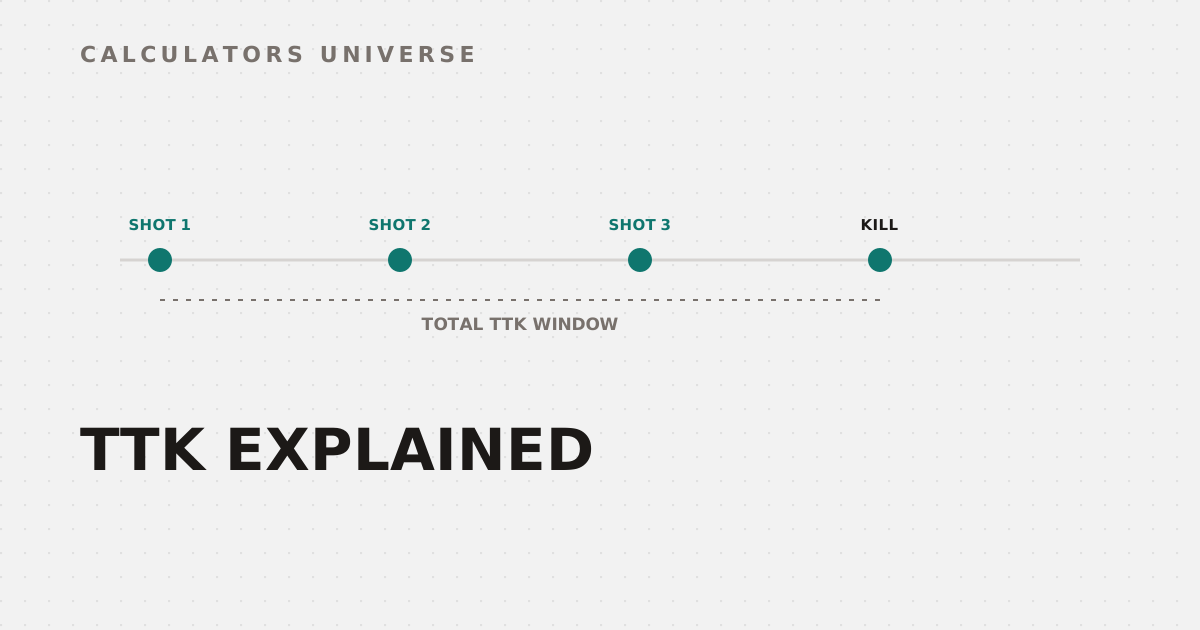
TTK is the time between your first shot and the kill, assuming every shot after the first lands and the weapon fires at its normal rate. The formula:
TTK (ms) = (Shots to Kill − 1) × (60,000 ÷ RPM)
The −1 matters: the first shot fires at time zero, so only the gaps between shots add time. A weapon firing at 600 RPM fires once every 100ms. If it takes 4 shots to kill, that’s 3 gaps of 100ms each — a 300ms TTK. Double the fire rate to 1200 RPM with the same 4-shot kill, and TTK drops to 150ms.
This is exactly what the TTK Calculator computes for any weapon, letting you compare two loadouts side by side instead of estimating by feel.
TTK vs. HTK — Two Numbers People Mix Up
TTK is a duration (milliseconds). HTK (hits-to-kill) is a count (number of shots), and it changes with range falloff, armor plates, and headshot multipliers — the same weapon can have a 2-shot HTK up close and a 5-shot HTK at range, which directly changes its TTK at each distance. The Headshot-to-Kill Breakpoint Calculator works out the exact HTK breakpoints armor and range create, which then feeds directly into the TTK formula above.
Why Low TTK Feels More Punishing
Illustrative comparison — when TTK approaches average simple visual reaction time (roughly 200-250ms), the player being shot literally cannot react before the kill
Human simple visual reaction time averages roughly 200–250ms, even for trained players. When a weapon’s TTK sits near or below that number, the player being shot has no realistic window to turn, aim, and return fire — the fight is effectively decided by who fired first, not who aimed better afterward. That’s why fast-TTK shooters feel unforgiving: they compress the gap between “spotted” and “dead” below the floor of human reaction speed. Slower-TTK games leave enough room that a losing engagement can still be won by tracking, cover use, or utility — reaction speed matters less because there’s simply more time in the window.
TTK, Ping, and Peeker’s Advantage
Network latency compounds this effect. In most shooters, the player moving into an engagement (the “peeker”) sees the opponent slightly before their own position updates on the defender’s screen, due to how each client renders the other’s position. Combined with a short TTK, this peeker’s advantage can decide a fight before the defender’s client has even rendered the threat. Calculate the exact millisecond advantage your ping gives you (or costs you) with the Peeker’s Advantage Latency Calculator, and check how your reaction time maps to a realistic competitive rank ceiling with the Reaction Time Rank Ceiling Calculator.
Compensating for TTK You Can’t Change
You can’t change a game’s base TTK, but you can change how much of your own reaction window you actually get to use:
- Higher refresh rate monitors sample your opponent’s position more often inside the same TTK window — more frames means more chances to perceive movement and react before the window closes. Find the refresh rate your GPU can actually sustain with the Monitor Hz vs FPS Matcher.
- Loadout economy matters in games like Warzone, where armor plates and self-revives directly extend your effective HTK and buy back reaction time mid-fight — plan your squad’s buy-station budget with the Warzone Loadout Cost Calculator.
Frequently Asked Questions
What is a “good” TTK for a competitive shooter?
There’s no universally “good” number — short TTK (under ~300ms) rewards positioning and first contact, while longer TTK (500ms+) rewards sustained aim and lets losing fights be turned around. Competitive titles choose based on the skill expression they want to emphasize.
Why does CS2 feel more punishing than Overwatch 2?
CS2’s high-damage weapons produce a very short TTK at most ranges, meaning the first accurate shot often decides the engagement. Overwatch 2’s hero kits generally have longer TTK and built-in mobility/healing, giving losing fights more room to turn around.
Does a higher refresh rate monitor actually help against a short TTK?
Yes, meaningfully — more frames per second inside the same TTK window means more opportunities to perceive an opponent’s movement and react, even though it can’t make your raw reaction time faster.
Is TTK the same as DPS (damage per second)?
No. DPS assumes continuous fire over a full second and ignores magazine size, reload, and the exact shot count needed to kill — TTK is the specific real-world time to land a kill against a target with defined health, which is usually far more relevant in a real gunfight.
Does armor change TTK?
Yes — armor increases effective health, which increases the shots (and therefore hits-to-kill) needed to eliminate a target, which directly lengthens TTK against that target using the same weapon.
Related Calculators
Start with the TTK Calculator to compare weapons directly, layer in armor and range with the Headshot-to-Kill Breakpoint Calculator, and see how ping and reaction time interact with the Peeker’s Advantage Latency Calculator and Reaction Time Rank Ceiling Calculator. Then check your monitor’s real capability with the Monitor Hz vs FPS Matcher and your squad’s economy with the Warzone Loadout Cost Calculator.
External Resources
- Mental Chronometry — Wikipedia — background on how human reaction time is measured and studied
- Glossary of Video Game Terms — Wikipedia — reference for TTK and related competitive shooter terminology