What3Words vs Coordinates vs MGRS: Comparing Location-Sharing Systems for Emergencies
What3Words is memorable but proprietary and has been criticized by UK mountain rescue. Here's how it really compares to coordinates, MGRS, and Plus Codes.
What3Words vs Coordinates vs MGRS: Which Should You Actually Trust?
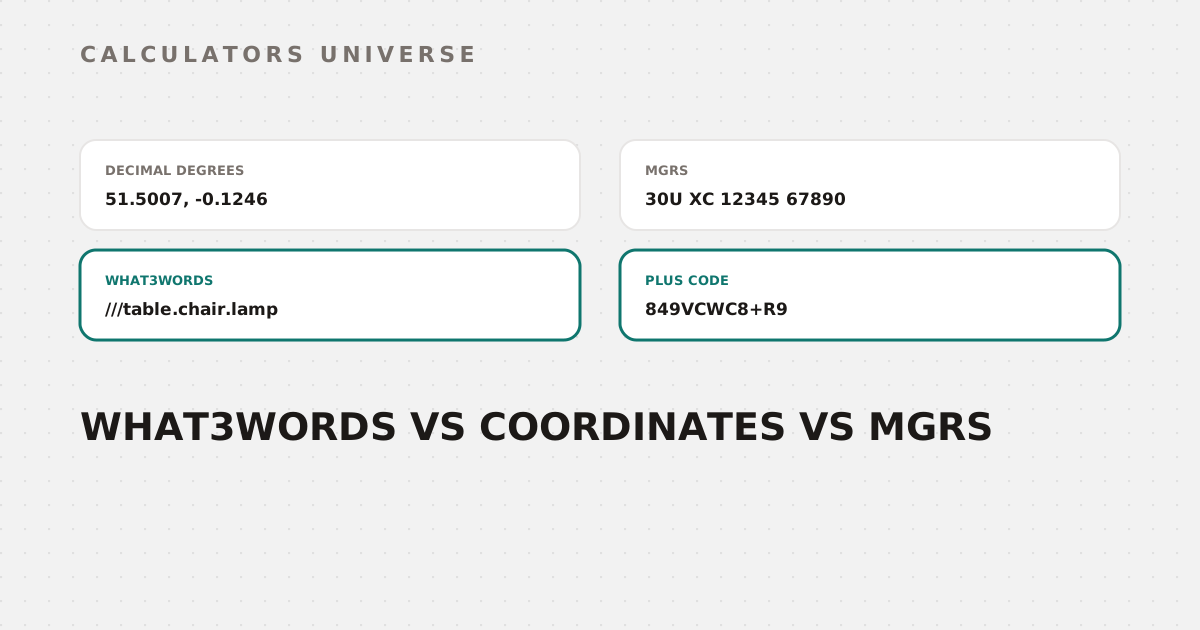
“Just send me your location” now has four genuinely different answers: decimal coordinates, MGRS, What3Words, or a Google Plus Code. Each is a real, actively used system — and one of them has been the subject of real, documented safety criticism from professional rescue services, which is worth knowing before you rely on it in an emergency.
Illustrative format examples — each system encodes location completely differently
Decimal Coordinates: The Universal Baseline
Latitude and longitude in decimal degrees is what every GPS device, dispatch system, and mapping API understands natively — the one format guaranteed to work everywhere without translation. The tradeoff is exactly what makes the other three systems exist: it’s long to read aloud, easy to mishear a digit, and error-prone to transcribe under stress. Convert between decimal and DMS notation with the Lat/Long to DMS Converter, or move between any of the standard formats with the Coordinate Converter.
MGRS: Built for Radio, Not Consumers
As covered in our UTM vs Lat/Long vs MGRS guide, MGRS packs a zone, 100km grid square, and precise offset into one compact alphanumeric string specifically designed to survive radio transmission cleanly. It’s the standard for military and increasingly formal emergency-response coordination — but it assumes trained users and existing infrastructure, which is exactly the gap the next two systems try to fill for the general public.
What3Words: Memorable, But Not Without Real Controversy
What3Words, launched in July 2013 by a UK-based company, divides the globe into roughly 57 trillion 3-by-3-meter squares, each assigned a unique three-word address. It’s genuinely easy to say and remember, and UK emergency services have integrated it into some 999 control room systems, credited with helping locate people in real incidents.
It also has real, documented drawbacks worth taking seriously. The underlying algorithm is proprietary and closed-source, meaning it can’t be independently audited the way an open standard can. More concretely: the Lake District Search and Mountain Rescue Association publicly warned in 2019 that “mishearing or misspelling words tended to cause problems,” advising hikers not to rely on it, and a 2023 academic paper concluded that What3Words “should not be adopted as critical infrastructure without a thorough evaluation against a number of competing alternatives.” Generate a What3Words address (or decode one back to coordinates) with the Coordinate to What3Words & Plus Code Converter.
Google Plus Codes: The Open-Source Alternative
Plus Codes (Open Location Code), released by Google’s Zurich engineering office in October 2014, solve a similar problem — a short, shareable code instead of raw coordinates — using an openly published, Apache 2.0-licensed algorithm instead of a proprietary one. A code like 849VCWC8+R9 can often be shortened to just CWC8+R9 when paired with a nearby locality name, and it’s not case-sensitive, making it easy to read over a phone call. Plus Codes have seen real adoption specifically in places without a formal street addressing system, including areas of Cape Verde and parts of India. The same Coordinate to What3Words & Plus Code Converter generates a Plus Code alongside the What3Words address for any coordinate.
Which Should You Actually Use?
| Situation | Recommended System |
|---|---|
| Talking to a GPS device, mapping API, or dispatcher software | Decimal coordinates |
| Formal emergency/military coordination with existing MGRS infrastructure | MGRS |
| Sharing a memorable location verbally, as a supplement — not sole reliance | What3Words |
| Addressing in areas without formal street systems, open-source preference | Plus Codes |
The most defensible practice in a genuine emergency: share decimal coordinates as the unambiguous fallback whenever possible, and treat memorable formats like What3Words as a convenient supplement rather than a sole source of truth — exactly the caution UK mountain rescue services have publicly recommended.
Beyond the Address: What Else Matters
Once a location is shared, two more practical questions often follow. If coordinating across regions, confirm the local time context with the Timezone from Coordinates Lookup. And to understand how far responders or a rendezvous point actually is from a shared location, calculate the distance and bearing with the Distance & Bearing Calculator.
Frequently Asked Questions
Is What3Words reliable enough for emergencies?
It has helped in real documented cases, but professional rescue organizations have publicly cautioned against relying on it as a sole location method, citing its closed-source algorithm and the real risk of mishearing or misspelling similar-sounding words.
What’s the actual difference between What3Words and Plus Codes?
Both compress a location into a short shareable code, but What3Words uses a proprietary, closed algorithm with dictionary words, while Plus Codes use an openly published, Apache-licensed grid algorithm with an alphanumeric code.
Why do some agencies still prefer MGRS or plain coordinates?
Both are open, standardized systems with decades of established infrastructure and training behind them, unlike newer proprietary systems whose long-term availability and auditability are less certain.
Can a What3Words address ever change?
The company controls the underlying word-grid mapping, so unlike an open standard, users depend on that one company maintaining and not altering the system — a structural difference from open formats like MGRS or Plus Codes.
Are Plus Codes actually open source?
Yes — the Open Location Code algorithm is published on GitHub under the Apache License 2.0, meaning anyone can implement, audit, or extend it without depending on a single company.
Related Calculators
Start with the Coordinate to What3Words & Plus Code Converter to generate both modern formats at once, fall back to the universal Coordinate Converter and Lat/Long to DMS Converter when precision matters most, and use the MGRS to Lat/Long Bulk Converter for formal grid reference work. Add context with the Timezone from Coordinates Lookup and Distance & Bearing Calculator.
External Resources
- What3words — Wikipedia — history, adoption, and documented criticism
- Open Location Code — Wikipedia — technical background on the Plus Codes grid algorithm