How Much Do Twitch and YouTube Streamers Actually Make? A Revenue Breakdown
Twitch, Kick, and YouTube split subscription and ad revenue very differently. The real 2026 percentages and a worked comparison per 1,000 subscribers.
How Much Do Streamers Actually Make? A Real Revenue Breakdown
“How much do streamers make” doesn’t have a single answer, because the platform a creator streams on can change their take-home pay by thousands of dollars for the exact same audience. Twitch, Kick, and YouTube each split subscription and ad revenue completely differently — and most of those splits changed meaningfully within the last two years. Here’s the real 2026 math.
Twitch: Subs, Bits, and the Plus Program
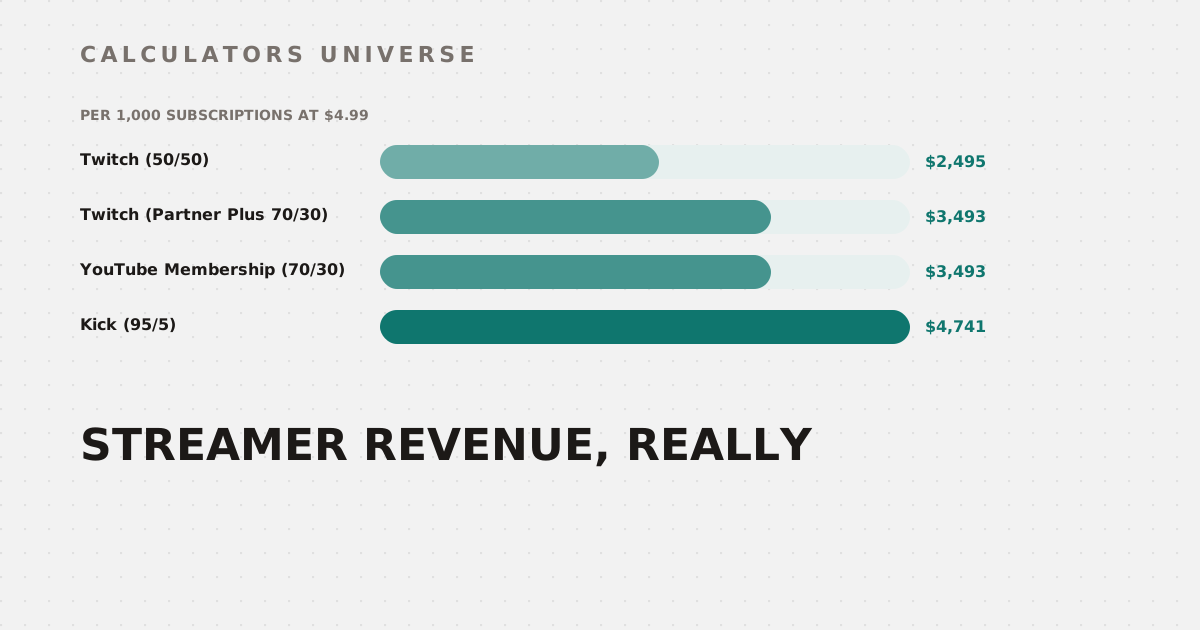
Twitch’s default subscription split is 50/50 for Affiliates and most Partners — a $4.99 Tier 1 sub nets the streamer $2.50. Higher splits are only available through the Partner Plus program: reach 100 sustained Plus Points (roughly tracking sub count and tier mix) for 3 consecutive months and you move to 60/40; reach 300 Plus Points and you reach the top 70/30 tier, worth roughly $3.50 per Tier 1 sub. Only an estimated 8–12% of Partnered streamers ever qualify for a split above 50/50.
Bits (Twitch’s virtual cheer currency) pay a flat, unchanging rate: streamers always receive $0.01 per Bit, regardless of channel size or how much the viewer paid to buy that Bit (viewers pay roughly $0.0123–$0.014 per Bit depending on bundle size — the difference is Twitch’s cut). This rate has been fixed since Bits launched in 2016.
Kick: The 95/5 Pitch
Kick’s entire creator pitch is a dramatically higher default split: 95/5 on subscriptions, Kicks (their bits equivalent), and gifted subs, with 0% taken from direct tips. On a $4.99 subscription, that’s $4.74 to the streamer — nearly double Twitch’s default 50/50 rate, and still meaningfully ahead of Twitch’s hard-to-reach 70/30 tier.
YouTube Gaming: Ads, Memberships, and the Overlooked Premium Cut
YouTube’s ad revenue split is 55/45 in the creator’s favor for long-form content (Shorts pool ad revenue platform-wide and distribute a share proportional to views, after music licensing costs). Separately, Channel Memberships and Super Chat/Super Thanks run on a 70/30 split favoring the creator — comparable to Twitch’s hardest-to-reach tier, but available without a multi-month qualification period. Gaming content typically runs a lower $1–4 CPM than higher-paying niches like finance, which is why memberships and Super Chat often matter more to gaming creators specifically than ad revenue alone. One frequently overlooked stream: YouTube Premium revenue, distributed proportional to watch time from Premium subscribers, which can add 10–20% to a large creator’s total earnings without appearing as a distinct line item.
Same 1,000 subscribers, same $4.99 price point — the platform split alone accounts for a $2,246 swing
Turning This Into Your Own Numbers
- Estimate your actual monthly income from subs, Bits, and ad revenue — use the Twitch Payout Estimator.
- Compare your specific take-home across Twitch, Kick, and YouTube Gaming, including payment fees and taxes — use the Twitch vs. Kick vs. YouTube Revenue Split Calculator.
- Revenue depends on retaining viewers long enough to convert them into subscribers — measure your actual audience churn with the Stream Viewer Retention Calculator.
- Factor in the often-ignored operational cost of your content — estimate your recording storage needs with the VOD Storage Calculator.
- Competing in tournaments alongside your regular streaming income? Split any prize pool correctly with the Esports Prize Split Calculator.
- Streaming competitive FPS titles brings its own revenue-protection concern — set a safe broadcast delay with the Stream Snipe Delay Calculator.
Frequently Asked Questions
How much does a streamer make per subscriber?
On a standard $4.99 tier, roughly $2.50 on Twitch’s default 50/50 split, $3.50 at Twitch’s top 70/30 Partner Plus tier, $3.50 on a YouTube 70/30 membership, or $4.74 on Kick’s 95/5 split — the platform alone nearly doubles or halves the number.
Is Kick actually better for creators than Twitch?
On pure revenue share, yes — Kick’s 95/5 split significantly outpaces even Twitch’s hardest-to-reach 70/30 tier. Platform audience size, discoverability, and advertiser demand are separate factors that don’t show up in the revenue split alone.
How much is a Twitch Bit worth to the streamer?
Exactly $0.01 per Bit, a rate that hasn’t changed since Bits launched in 2016, regardless of channel size or which bundle the viewer purchased.
Do streamers keep 100% of donations and tips?
Direct tips generally bypass the platform’s subscription/Bits revenue share and go straight to the creator’s payment processor, though processor fees still apply — Kick explicitly takes 0% from direct tips, for example.
Why do gaming YouTubers rely so much on memberships instead of just ads?
Gaming content typically runs a lower ad CPM ($1–4) than higher-paying niches, while Channel Memberships run a flat 70/30 split in the creator’s favor — for many gaming channels, memberships end up mattering more than ad revenue.
Related Calculators
Start with the Twitch Payout Estimator for your own numbers, then compare platforms directly with the Twitch vs. Kick vs. YouTube Revenue Split Calculator. Track the audience health behind that revenue with the Stream Viewer Retention Calculator, plan storage costs with the VOD Storage Calculator, split tournament winnings fairly with the Esports Prize Split Calculator, and protect competitive streams with the Stream Snipe Delay Calculator.
External Resources
- Twitch Partner Program — official Partner Program and Partner Plus revenue split details
- Understanding Kick’s Revenue Split — Kick’s official help center breakdown of its 95/5 creator split