Stopping Sight Distance Explained: Why Highway Curves Have Speed Limits
Every advisory speed sign traces back to one AASHTO calculation: can a driver actually stop in time? The real formula behind stopping and passing sight distance.
Stopping Sight Distance Explained: Why Curves Have Speed Limits
That advisory speed sign before a curve isn’t a guess — it comes from a specific AASHTO calculation answering one question: at this speed, can a driver actually see far enough ahead to stop before hitting something? Two related but distinct calculations govern this: stopping sight distance (can you stop in time?) and passing sight distance (can you see far enough to safely pass?).
Stopping Sight Distance: Two Distances Added Together
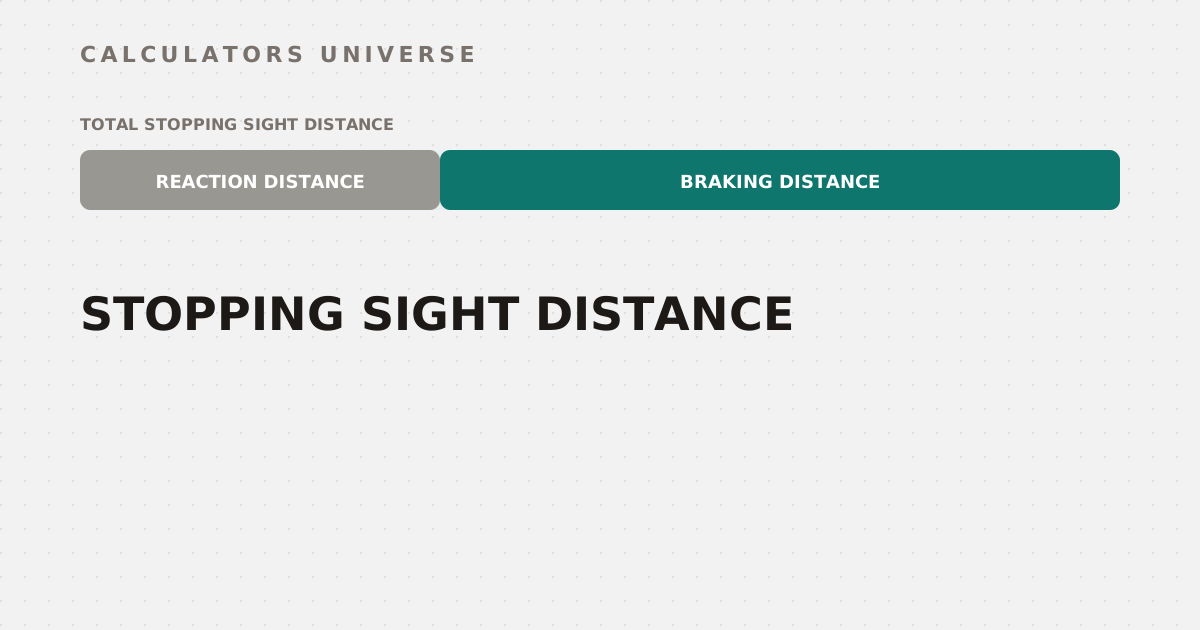
Stopping sight distance (SSD) is the sum of two separate distances covering two separate phases of a stop:
- Brake reaction distance — how far the vehicle travels between the driver perceiving a hazard and actually applying the brakes.
- Braking distance — how far the vehicle travels while decelerating to a stop.
Braking distance dominates total SSD and grows with the square of speed
The AASHTO formula: SSD = 1.47Vt + 1.075V²/a (US customary units — V in mph, t = reaction time in seconds, a = deceleration rate in ft/s²), with the braking term adjusted for grade in its fuller form. The standard reaction time, 2.5 seconds, is calibrated to cover roughly 90% of drivers in typical highway conditions — and it’s a fixed constant, while the braking distance term grows with the square of speed, which is why small speed increases produce disproportionately larger stopping distances. Downgrades increase required SSD (gravity adds to the vehicle’s momentum); upgrades reduce it. Calculate the exact required distance for your design speed, grade, and friction assumptions with the Stopping Sight Distance Calculator.
Why Curves Physically Block Sight Distance
A road can have plenty of straight-line sight distance and still fail on a horizontal curve — because the inside of the curve itself (a cut slope, retaining wall, guardrail, or roadside vegetation) can physically block the driver’s line of sight to a hazard ahead, even though nothing is wrong with the pavement.
Bird's-eye view: the chord line-of-sight cuts across the inside of the curve
The required clearance is defined by the curve’s middle ordinate — the distance from the road centerline to the sightline chord at the curve’s midpoint — calculated from the curve radius and the required stopping sight distance itself. Anything inside that clearance zone has to go: relocate the obstruction, flatten the cut slope, or increase the curve radius. Find the minimum lateral clearance for any curve with the Sight Distance Obstruction Calculator.
This same SSD requirement is also exactly what sizes a crest vertical curve — the curve has to be long enough that the road surface itself doesn’t block the driver’s line of sight over the top of the hill, using the K-value method covered in our horizontal and vertical curve guide.
Passing Sight Distance: A Much Longer, Four-Part Calculation
Passing sight distance (PSD) answers a harder question than SSD: not just “can I stop,” but “can I see far enough ahead to safely complete an entire passing maneuver around an oncoming vehicle and return to my lane before we meet?” AASHTO breaks this into four separate distances:
- d1 — distance traveled during perception-reaction and initial acceleration to the point of moving into the opposing lane
- d2 — distance traveled while occupying the opposing lane
- d3 — clearance distance between the passing and opposing vehicle at the end of the maneuver (roughly 30–90 meters depending on speed)
- d4 — distance the opposing vehicle covers during two-thirds of the time the passing vehicle spends in its lane (roughly 97–209 meters depending on speed)
Because it has to account for an entire multi-second maneuver plus a safety margin against an oncoming vehicle, PSD is dramatically longer than SSD at the same design speed — which is exactly why passing zones are so much rarer than the general “can you stop” requirement that applies everywhere. Work out all four phase distances with the Passing Sight Distance Calculator.
Where Cross-Section and Widening Fit In
Sight distance doesn’t exist in isolation from the rest of the roadway design. The road’s cut/fill cross-section — carriageway width, shoulders, side slopes, and ditches — determines how much physical room actually exists at the roadside for the clear zone that sight distance planning assumes; check that geometry with the Road Cross-Section Area Calculator. Separately, curves also need extra pavement width beyond the base lane width — both “mechanical” widening (for the rear wheels tracking inside the front wheels through a turn) and “psychological” widening (for driver comfort at the curve’s apparent tightness) — calculated with the Pavement Widening on Horizontal Curves Calculator.
Frequently Asked Questions
What’s the difference between stopping sight distance and passing sight distance?
SSD is the distance needed to see a hazard and come to a complete stop — it applies everywhere. PSD is the much longer distance needed to see far enough ahead to safely complete an entire pass around a slower vehicle using the opposing lane — it only applies where passing is permitted.
Why does AASHTO use 2.5 seconds for reaction time?
It’s calibrated to cover roughly 90% of drivers under typical highway conditions — a deliberately conservative, standardized value rather than an average reaction time.
How does road grade affect stopping distance?
A downgrade increases the required stopping distance because gravity adds to the vehicle’s momentum during braking; an upgrade reduces it for the same reason in reverse.
Can a curve have adequate stopping sight distance on the pavement but still be unsafe?
Yes — this is exactly the horizontal sight obstruction problem: an object inside the curve (cut slope, wall, vegetation) can block the driver’s line of sight even when the roadway geometry itself would otherwise provide adequate distance.
Does curve widening affect sight distance?
Not directly — widening addresses vehicle tracking and driver comfort on curves, a related but separate safety parameter from the lateral clearance requirements that govern sight distance.
Related Calculators
Start with the Stopping Sight Distance Calculator and check horizontal curve clearance with the Sight Distance Obstruction Calculator. For overtaking zones, use the Passing Sight Distance Calculator. Round out the roadway design with the Road Cross-Section Area Calculator and Pavement Widening on Horizontal Curves Calculator.
External Resources
- Stopping sight distance — Wikipedia — background on the reaction and braking distance components
- FHWA — Engineering and Technical Concepts — official Federal Highway Administration reference on sight distance and speed design