The Quadratic Formula, Discriminant, and Completing the Square: Three Ways to Solve the Same Equation
The quadratic formula isn't separate from completing the square — it's derived from it. The real history, the derivation, and what the discriminant means.
The Quadratic Formula, Discriminant, and Completing the Square
Most algebra classes teach the quadratic formula and completing the square as two separate techniques for the same job. They’re not separate — the quadratic formula is literally what you get when you complete the square on the general equation ax² + bx + c = 0 once, and never have to do it again. Here’s that derivation, the real history behind it, and what the discriminant is actually telling you.
Completing the Square: Where the Formula Actually Comes From
Completing the square rewrites a quadratic as a perfect square plus a constant — turning ax² + bx + c into the vertex form a(x − h)² + k, where h = −b/2a and k = c − b²/(4a). This form directly reveals the parabola’s vertex coordinates (h, k) without any further work.
This geometric idea — literally completing a square's missing corner — predates modern algebraic notation entirely
The technique is genuinely ancient: Babylonian mathematicians used a geometric method equivalent to completing the square as early as 400 BC, working with areas rather than symbolic algebra, since algebraic notation as we use it today didn’t exist yet. Convert any quadratic to vertex form, with full step-by-step working and a parabola diagram, using the Completing the Square Calculator.
The Quadratic Formula: The General Solution
Completing the square on the general equation ax² + bx + c = 0 — once, symbolically, instead of repeating it for every specific equation — produces the quadratic formula: x = (−b ± √(b² − 4ac)) / 2a. It’s not a different method; it’s completing the square done in advance so you never have to redo the algebra by hand again.
The history here spans centuries: Brahmagupta’s 628 AD treatise gave a general method admitting negative numbers, equivalent to the “+” root of the modern formula. Bhaskara II later gave the first clear explanation of what the discriminant reveals about a solution’s nature. The formula didn’t reach its fully modern symbolic form until René Descartes included it in La Géométrie in 1637. Solve any quadratic instantly — with real or complex roots, the discriminant, vertex, and a graph — using the Quadratic Formula Calculator.
The Discriminant: What b² − 4ac Actually Tells You
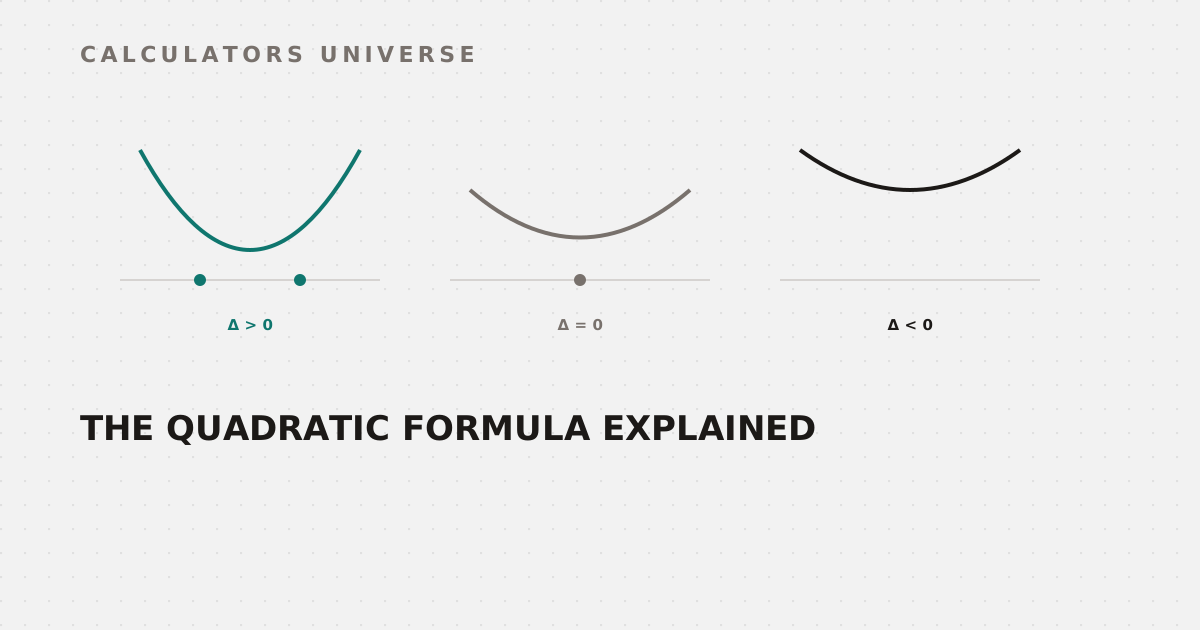
The expression under the square root, b² − 4ac, is called the discriminant, and its sign alone tells you what kind of solutions to expect before you even finish solving:
The discriminant's sign alone determines how many times the parabola crosses the x-axis
- Δ > 0: two distinct real roots — the parabola crosses the x-axis twice.
- Δ = 0: exactly one repeated real root — the parabola just touches the x-axis at its vertex.
- Δ < 0: no real roots, only a complex conjugate pair — the parabola never touches the x-axis at all.
This same discriminant logic extends beyond quadratics to cubic and quartic equations, where root-nature analysis gets more involved. Find all real and complex roots for polynomials up to degree four, with the discriminant and factoring method shown, using the Polynomial Roots Calculator.
Beyond One Equation: Systems and Inequalities
Quadratics rarely show up in isolation. Sometimes you need to solve for two unknowns across multiple equations at once — handled by full step-by-step Gaussian elimination in the System of Equations Solver, for both 2×2 and 3×3 systems. Sometimes the building block is simpler — a single linear equation of the form ax + b = c — solved with every algebraic step, including unique, infinite, and no-solution cases, by the Linear Equation Solver. And sometimes the question isn’t “where does this equal zero” but “where is this greater or less than zero” — solved with sign analysis and a number-line graph by the Inequality Solver, which handles both linear and quadratic cases.
Frequently Asked Questions
Is the quadratic formula a different method from completing the square?
No — the quadratic formula is the result of completing the square done once on the general equation, so the algebra never has to be repeated by hand for each specific case.
What does the discriminant actually tell you?
Its sign alone reveals the number and type of roots: positive means two distinct real roots, zero means one repeated real root, and negative means no real roots (only a complex conjugate pair).
Who actually invented the quadratic formula?
No single person — Babylonian mathematicians used an equivalent geometric method by 400 BC, Brahmagupta gave a general algebraic method in 628 AD, Bhaskara II clarified the discriminant’s role, and René Descartes wrote the formula in its modern symbolic form in 1637.
Does completing the square always work?
Yes — it works for any quadratic equation, which is exactly why it can be generalized once into the quadratic formula rather than repeated by hand every time.
What’s the difference between solving an equation and an inequality?
An equation asks for the exact point(s) where an expression equals zero; an inequality asks for the entire range of values where it’s greater than or less than zero, which requires sign analysis across intervals rather than a single point answer.
Related Calculators
Start with the Completing the Square Calculator to see where the formula comes from, then solve directly with the Quadratic Formula Calculator or extend to higher degrees with the Polynomial Roots Calculator. For related algebra, use the Linear Equation Solver, System of Equations Solver, and Inequality Solver.
External Resources
- Quadratic formula — Wikipedia — background on the formula’s derivation and properties
- Quadratic equations — MacTutor History of Mathematics — detailed historical account from Babylonian methods through Descartes