Minecraft Redstone Tick Timing: A Complete Technical Reference
Game ticks, redstone ticks, repeater delays, and hopper rates — the exact millisecond math behind every Minecraft redstone build, farm, and server TPS number.
Minecraft Redstone Tick Timing: A Complete Technical Reference
Every redstone contraption, every farm’s items-per-hour, and every server’s performance number in Minecraft ultimately reduces to the same unit: the tick. Once you know how many milliseconds a tick actually represents — and how that number quietly changes under load — timing a repeater chain or estimating a farm’s real output stops being guesswork.
The Game Tick: Minecraft’s Actual Clock
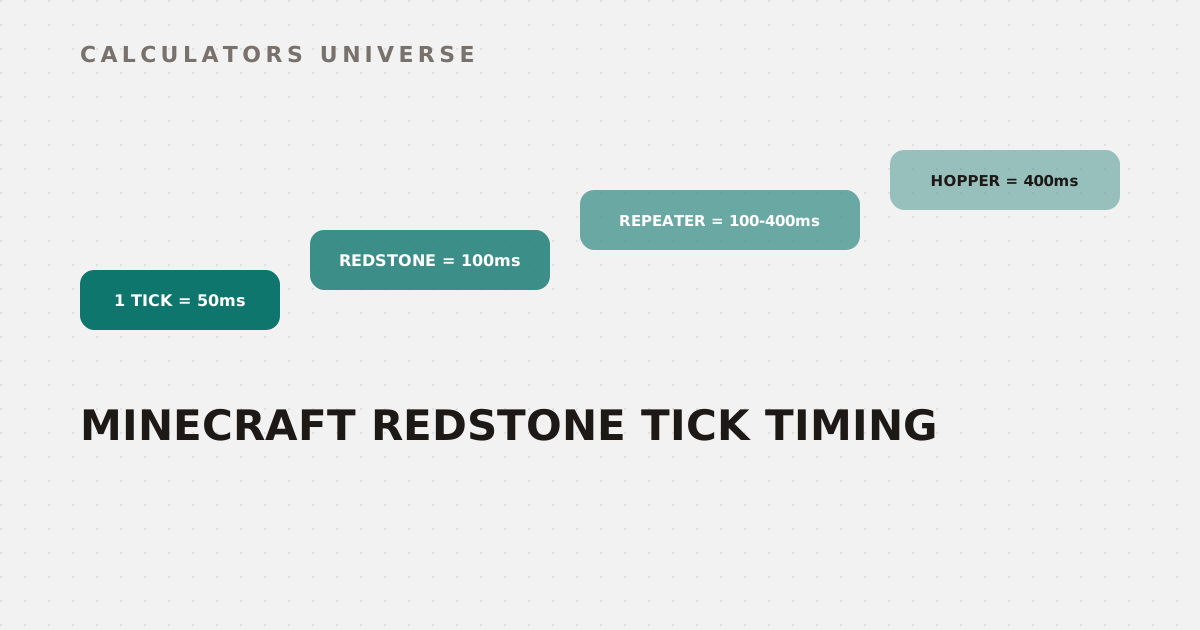
Minecraft’s simulation runs at a fixed rate of 20 ticks per second, meaning one game tick equals exactly 50 milliseconds under normal conditions. Every scheduled event in the game — crop growth, mob AI, hunger drain, redstone updates — is counted in ticks, not seconds, because ticks are the only unit the game engine actually processes.
The Redstone Tick: Why Redstone Feels Slower
Redstone doesn’t update every single game tick — it updates every 2 game ticks, a unit called the redstone tick, equal to 100 milliseconds. This is a historical engine convention that has stayed consistent for over a decade, and it’s the reason redstone timing always comes out to clean multiples of 100ms rather than 50ms.
Repeater Delay: Building Exact Timing Chains
A redstone repeater’s delay is measured in redstone ticks, adjustable from 1 to 4:
| Repeater Setting | Redstone Ticks | Game Ticks | Delay |
|---|---|---|---|
| Setting 1 (default) | 1 | 2 | 100ms |
| Setting 2 | 2 | 4 | 200ms |
| Setting 3 | 3 | 6 | 300ms |
| Setting 4 (max) | 4 | 8 | 400ms |
Every redstone timing number is a multiple of the 50ms game tick — this is why builds "just work" once you know the base unit
Chaining repeaters at maximum delay gives you fine control over any timing requirement — need an exact 1,200ms delay? That’s 3 repeaters at maximum (4 redstone ticks each). Working out delay chains by hand gets tedious fast; the Minecraft Tick Calculator converts any target delay into an optimal repeater chain instantly, alongside a full component timing reference.
Where This Directly Sets Farm Output
Hoppers — the backbone of almost every automated farm — have their own fixed timing: after moving an item, a hopper enters an 8 game tick (400ms) cooldown, capping any single hopper line at 2.5 items per second. This one number is why farm output doesn’t scale infinitely just by adding more hoppers to a line; you’re bottlenecked by tick timing, not by anything else in the build. The Minecraft Farm Rates Calculator factors this exact bottleneck into its items-per-hour and XP-yield numbers for iron golem, gold, mob, and crop farms.
When Ticks Aren’t Actually 50ms: Server Lag and MSPT
Everything above assumes the server can process a tick within its 50ms budget. The real measurement here is MSPT (milliseconds per tick) — the server’s actual processing time for one tick. As long as MSPT stays at or under 50ms, the server holds a steady 20 TPS (ticks per second) and every timing number above holds exactly. Once MSPT climbs above 50ms — from heavy redstone farms, crowded mob caps, or a stack of resource-intensive mods — the server can no longer keep up, TPS drops below 20, and every tick-based system in the game effectively runs in slow motion, including the redstone timing and farm rates above.
This is precisely why server RAM sizing and mod compatibility matter for anything beyond casual play: undersized RAM or conflicting mods are the most common causes of MSPT creeping past budget. Size your server correctly with the Minecraft Server RAM Calculator, and check whether your mod list is likely to cause the loader conflicts or performance drag that push MSPT over budget with the Minecraft Mod Compatibility Checker.
Frequently Asked Questions
How long is one Minecraft tick in real time?
50 milliseconds, based on the game’s fixed rate of 20 ticks per second — as long as the server or client isn’t lagging.
Why is a redstone tick 100ms instead of 50ms?
Redstone updates run on a 2-game-tick cycle by long-standing engine design, so a redstone tick is always double the base game tick: 100ms.
What’s the maximum delay a single repeater can add?
4 redstone ticks, equal to 400 milliseconds. Longer delays require chaining multiple repeaters.
Does server lag actually change how long a tick takes?
The tick count itself doesn’t change, but if MSPT exceeds 50ms, ticks take longer to process in real time — meaning redstone timing and farm cycles that are exact “on paper” run measurably slower in practice.
Why can’t I just add more hoppers to speed up my farm?
Each hopper line is capped at 2.5 items per second by its fixed 8-game-tick cooldown — adding parallel hopper lines increases total throughput, but a single line can’t be sped up past that hardware-level limit.
Related Calculators
Start with the Minecraft Tick Calculator to convert any delay into an exact repeater chain, then estimate real farm output with the Minecraft Farm Rates Calculator and track the XP it generates with the Minecraft XP Level Calculator. For server-side timing accuracy, size your RAM correctly with the Minecraft Server RAM Calculator, check mod stacks for TPS risk with the Minecraft Mod Compatibility Checker, and once your resources are flowing, plan your build with the Minecraft Beacon Calculator.
External Resources
- Tick — Minecraft Wiki — the community wiki’s full technical reference on game ticks and TPS
- Hopper — Minecraft Wiki — official mechanics reference for hopper transfer cooldown and item movement