Minecraft Beacon Calculator: Why a Basic Gold Farm Beats a Basic Iron Farm
A basic gold farm fills a Level 4 beacon's 1,476-ingot requirement in 18.45 hours — nearly half the 36.9 hours a basic iron golem farm needs. The real farm-rate math behind beacon material costs.
Minecraft Beacon Calculator: Why a Basic Gold Farm Beats a Basic Iron Farm
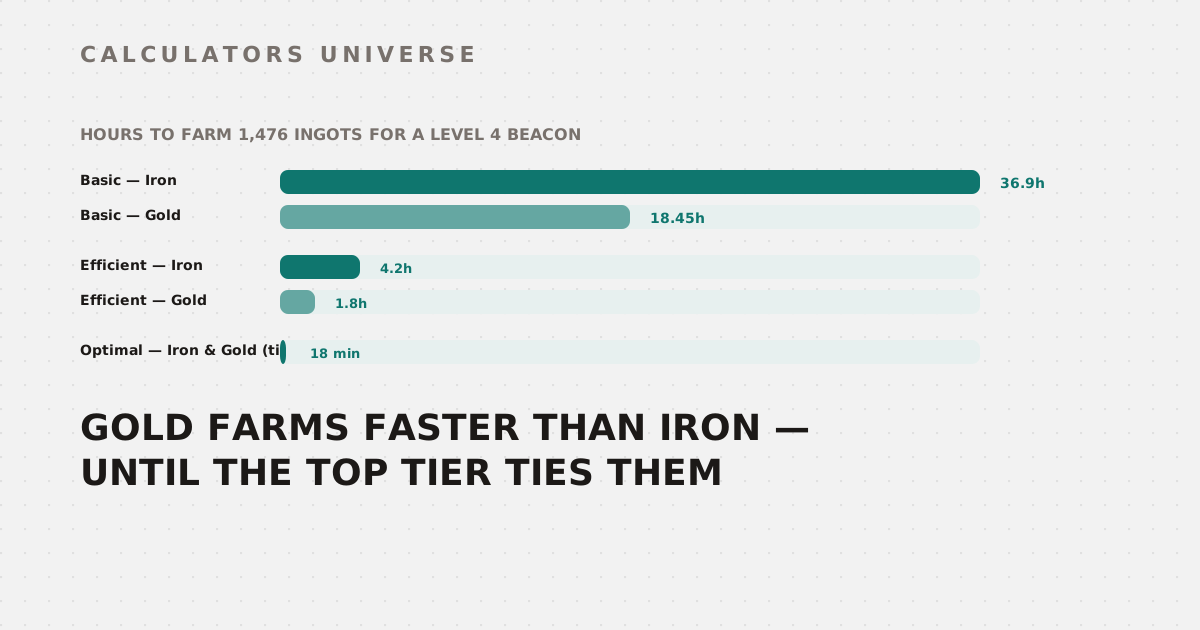
A full Level 4 beacon pyramid needs exactly 1,476 mineral items — 164 blocks, each crafted from 9 ingots or gems. Conventional wisdom says iron is the “smart” choice and gold is “harder to farm in bulk,” but run the real farm-rate numbers and a basic gold farm actually fills that 1,476-item requirement in 18.45 hours, against 36.9 hours for a basic iron golem farm — nearly twice as fast. The Minecraft Beacon Calculator tells you exactly how many items you need for any pyramid level; here’s what that number actually costs in real farming time, using verified rates from this site’s own farm-rate data.
The Pyramid Requirement, By Level
Every beacon pyramid level adds one more square layer beneath the beacon block, and each layer’s block count comes straight from its side length squared:
| Level | Base size | Blocks (cumulative) | Items needed (blocks × 9) |
|---|---|---|---|
| 1 | 3×3 | 9 | 81 |
| 2 | 5×5 + 3×3 | 34 | 306 |
| 3 | 7×7 + 5×5 + 3×3 | 83 | 747 |
| 4 (max) | 9×9 + 7×7 + 5×5 + 3×3 | 164 | 1,476 |
All five valid materials — Iron, Gold, Diamond, Emerald, Netherite — produce an identical beacon effect regardless of which one fills the pyramid. The only real variable is how long it takes to gather 1,476 units of whichever one you pick.
Real Farm Rates: Iron vs. Gold
Iron and Gold are the only two beacon materials with an automatable mob farm — Iron Golem farms and Zombified Piglin (gold) farms both have measured community benchmark rates across three build tiers:
| Farm tier | Iron Ingots/hour | Gold Ingots/hour | Hours to reach 1,476 (Iron) | Hours to reach 1,476 (Gold) |
|---|---|---|---|---|
| Basic | 40 | 80 | 36.9h | 18.45h |
| Efficient | 350 | 800 | 4.22h | 1.85h |
| Optimal | 4,800 | 4,800 | 0.31h (~18 min) | 0.31h (~18 min) |
Two things stand out. First, at both the Basic and Efficient tiers, a gold farm produces raw ingots meaningfully faster than an equivalent-tier iron farm — roughly double the throughput at Basic, and more than double at Efficient. Second, at the Optimal tier, the two converge to an identical 4,800 items/hour, meaning a fully optimized farm of either type fills a Level 4 beacon’s entire material cost in about 18 minutes.
The reason gold outpaces iron at lower tiers comes down to spawn mechanics: a simple nether zombified piglin platform generates a much higher mob density per hour than an early-game village-based iron golem setup, even though the golem farm has a reputation as the “essential” early build. The gap closes at the top tier because both farm types are ultimately capped by the same stacked-cell / portal-cramming spawn-space optimization once fully built out.
Why Diamond, Emerald, and Netherite Don’t Have This Table
Iron and Gold are the only beacon materials with a comparable automated farm rate because they’re the only two that come from renewable mob drops. Diamonds are mined, emeralds come from trading or mining, and netherite is smelted from ancient debris — none of them has an equivalent “items per hour” farm benchmark, because none of them can be automated the same way. That absence is itself informative: choosing Diamond, Emerald, or Netherite for a beacon isn’t just more expensive per unit, it’s a fundamentally different (and much slower, more hands-on) acquisition process with no passive-farming shortcut at all.
Why the Investment Is Worth It
Beacon beam range scales directly with pyramid level — 20 blocks of effect radius per level, from 20 blocks at Level 1 up to 80 blocks at Level 4 — alongside unlocking Strength at Level 3 and Regeneration plus a Level II potency boost at Level 4. The material cost scales in the same direction: each additional level roughly triples the cumulative block count of the level before it (9 → 34 → 83 → 164), so the jump from Level 3 to Level 4 alone adds 81 more blocks (729 more items) than every previous level combined.
How to Use These Calculators Together
- Open the Minecraft Beacon Calculator and select your target pyramid level to get the exact item total you need.
- Open the Minecraft Farm Rates Calculator and select Iron Golem or Gold farm at your actual build tier.
- Divide the beacon calculator’s total item count by the farm calculator’s items-per-hour figure to get a real time estimate for your specific setup, rather than assuming every “iron farm” or “gold farm” performs the same.
Related Calculators
Check how much RAM your server needs to run these farms smoothly with the Minecraft Server RAM Calculator, convert farm and redstone timings with the Minecraft Tick Calculator, and get full items-per-hour breakdowns for every major farm type with the Minecraft Farm Rates Calculator. If you split time between Minecraft and shooters, compare weapon kill speed with the TTK Calculator, check your expected frame rate with the FPS Calculator, and audit your setup’s running cost with the Electricity Cost Calculator.
Frequently Asked Questions
Is a gold farm really faster than an iron farm for beacon material?
At the Basic and Efficient build tiers, yes — a basic gold farm produces roughly double the ingots per hour of a basic iron golem farm, and an efficient gold farm holds a similar edge. The two only tie once both are built out to their fully optimized tier, where each caps at 4,800 items per hour regardless of material.
Why don’t Diamond, Emerald, and Netherite have a farm-rate comparison?
Because none of them come from a renewable mob drop the way iron and gold do — diamonds and netherite components are mined, and emeralds come from mining or villager trading, so there’s no automatable “items per hour” farm design to benchmark them against. That absence of a farming shortcut is a real practical cost of choosing those materials, on top of their higher per-unit rarity.
Does Looting affect how fast I can farm beacon materials?
For gold, yes — a gold farm supports Looting, and the multiplier applies to the primary Gold Ingot drop itself, not just secondary nuggets and flesh, so a Looting III sword genuinely shortens the time to reach 1,476 gold ingots. Iron golems don’t support Looting at all, so an iron farm’s ingot rate is unaffected by whatever enchantment is on your sword.
Does simulation distance change how long a beacon material farm takes?
Yes, significantly — spawn-based farms like Iron Golem and Gold farms rely on mobs spawning within simulation distance, and reduced simulation distance directly cuts the effective spawn rate, which is why server or client render/sim settings matter as much as the farm’s physical design when estimating real farming time.
Is there a faster way to get beacon materials than farming?
Trading with villagers can supplement gold and emerald income, and dungeon or structure loot occasionally yields blocks directly, but for a full Level 4 beacon’s 1,476-item requirement, a dedicated farm is still the most reliable route for iron or gold. For diamond, emerald, or netherite beacons, direct mining and trading remain the only realistic paths since no comparable automated farm exists.
Iron’s reputation as the “sensible” beacon material holds up once a build is fully optimized, but the numbers say something different at the tier most players are actually building at — a basic gold farm gets the job done in half the time a basic iron farm does, purely because of how differently the two mobs spawn.
External Resources
- Minecraft Wiki — Beacon — the definitive reference on beacon mechanics, pyramid construction, and range formulas
- Minecraft Wiki — Iron Golem Farming — step-by-step iron farm designs and spawn-rate mechanics