IPv4, IPv6, and Subnetting Explained: The Math Behind Every Network
IPv4's global address pool ran out in 2011. Here's the real subnetting math behind CIDR notation, why IPv4 needed a workaround, and how IPv6 fixes it for good.
IPv4, IPv6, and Subnetting Explained: The Math Behind Every Network
The global pool of new IPv4 addresses ran out back in February 2011. The internet has been running on a workaround ever since — and understanding exactly why requires the same bit-level math that defines every subnet you’ll ever configure.
IPv4: 32 Bits, and Why It Ran Out
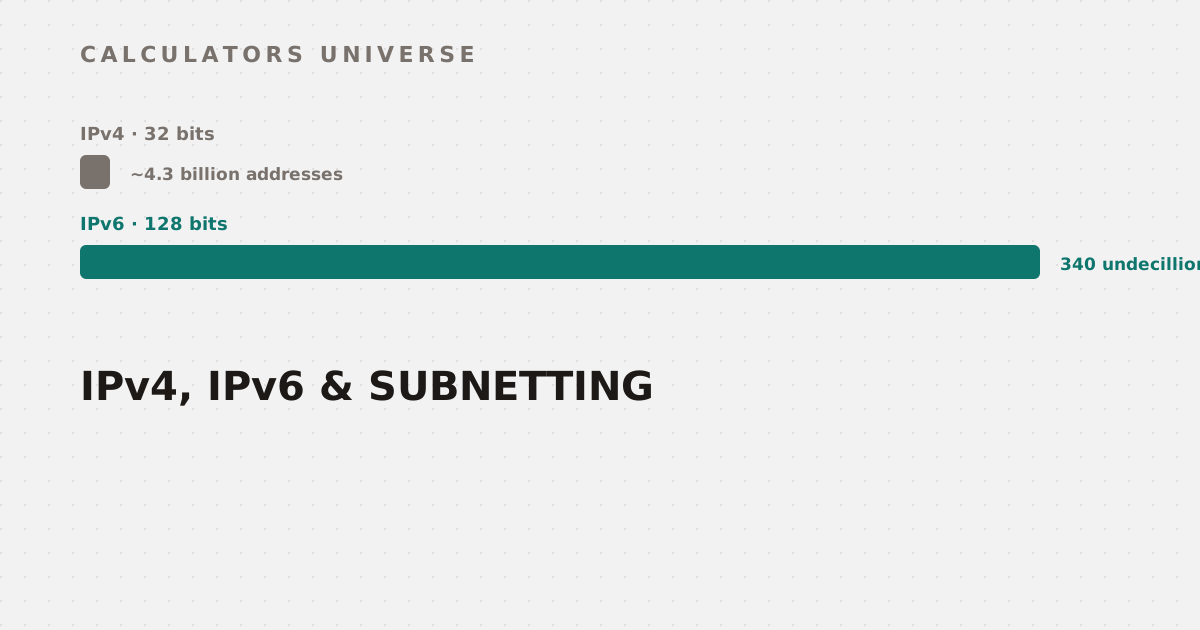
An IPv4 address is 32 bits, giving a theoretical maximum of about 4.3 billion addresses — a number that felt limitless in the 1980s and nowhere near enough for a planet of billions of connected devices. IANA allocated its last five unassigned address blocks to the five regional registries on February 3, 2011, exhausting the global free pool. Each region then ran out on its own timeline: APNIC (Asia-Pacific) first, on April 15, 2011; RIPE NCC (Europe) announced its last block in September 2012; LACNIC (Latin America) in June 2014; and ARIN (North America) on September 24, 2015. Look up any public IP’s location, network, and hosting details with the IP Address Lookup & Geolocation tool.
The Workaround: Private Addresses and NAT
IPv4 survived past 2011 through RFC 1918 private address ranges — 10.0.0.0/8 (16 million addresses), 172.16.0.0/12 (1 million addresses), and 192.168.0.0/16 (65,536 addresses) — combined with NAT (Network Address Translation), which lets an entire home or office full of devices share a single public IP address. Nearly every router you’ve ever used is running this exact workaround right now.
The slash in CIDR notation marks exactly where the network bits end and host bits begin
Visualize exactly how a subnet mask splits network and host bits — with a binary breakdown for any IP and CIDR — using the Visual IP Subnet Calculator.
CIDR Notation: The Math Behind the Slash
CIDR notation (like /24) states how many of the 32 bits are the fixed network portion — the rest are available for host addresses. A /24 leaves 8 host bits, giving 2⁸ = 256 total addresses, of which 254 are usable (the first is reserved as the network address, the last as the broadcast address). Analyze, split, summarize, or compare CIDR blocks — for IPv4 or IPv6 — with the CIDR Notation Calculator.
IPv6: Built So This Never Happens Again
IPv6 uses 128-bit addresses — not double IPv4’s size, but 2^96 times larger, yielding roughly 340 undecillion addresses (340,282,366,920,938,463,463,374,607,431,768,211,456, to the exact digit). Rather than variable network/host splits like IPv4, IPv6 standardizes on a fixed /64 subnet: 64 bits of network prefix, 64 bits reserved for the interface identifier — meaning a single subnet alone holds roughly 1.8×10¹⁹ addresses. A typical /48 allocation to an organization provides 65,536 separate /64 subnets.
Unlike IPv4's variable split, IPv6 fixes the boundary at exactly half the address
Calculate IPv6 prefixes, expand or compress an address, and see exact /64, /56, /48, and /128 ranges with the IPv6 Address Calculator.
Putting It to Use: DNS and Real Network Diagnostics
Addressing only matters once something actually resolves to it — a domain name maps to an IPv4 address through an A record or an IPv6 address through an AAAA record. Query any domain’s full DNS record set with the DNS Record Lookup tool. Once addressing and routing are working, the practical question becomes real throughput — estimate download, upload, or backup transfer time from file size and connection speed with the Network Speed to Transfer Time Calculator.
Frequently Asked Questions
Why did IPv4 run out of addresses?
Its 32-bit design allows only about 4.3 billion unique addresses, a number the internet’s device growth outpaced decades ago — IANA’s global free pool was fully exhausted on February 3, 2011.
What does /24 actually mean?
It means the first 24 of the address’s 32 bits are fixed as the network portion, leaving 8 bits (256 addresses, 254 usable) for hosts on that specific subnet.
How is IPv6 different from IPv4 besides being longer?
Beyond the vastly larger address space, IPv6 standardizes subnets at a fixed /64 split (64 network bits, 64 interface-ID bits), rather than IPv4’s variable-length network/host boundary.
Will IPv6 ever run out of addresses?
Not in any practical sense — its 340 undecillion address space is large enough that even wasteful fixed /64 allocations per subnet leave no realistic exhaustion scenario at current or foreseeable internet scale.
Why do I still see private IP addresses like 192.168.1.1 everywhere?
Because RFC 1918 private address ranges, combined with NAT, are exactly what let IPv4 keep functioning past 2011 — most home and office networks still run entirely on these private ranges behind a single public IP.
Related Calculators
Start with the Visual IP Subnet Calculator and CIDR Notation Calculator for IPv4 subnetting math, move to the IPv6 Address Calculator for the next-generation address space, look up any address with the IP Address Lookup & Geolocation tool, query domain records with the DNS Record Lookup, and estimate real transfer times with the Network Speed to Transfer Time Calculator.
External Resources
- IPv4 address exhaustion — Wikipedia — full history and regional registry exhaustion timeline
- IANA — the official authority for global IP address allocation and internet number resources