Horizontal and Vertical Curves Explained: The Highway Design Math Behind Every Road
Every road bend and grade change follows precise AASHTO geometry — tangent length, K-value, and superelevation. The real formulas behind highway curve design.
Horizontal and Vertical Curves Explained: The Math Behind Every Road
Every time a road bends or a hill rises and falls, a specific geometric formula decided exactly how sharply it could do that at the posted speed limit. None of it is guesswork — highway geometry follows AASHTO’s “Policy on Geometric Design of Highways and Streets” (the Green Book), and the same handful of formulas govern nearly every curve on every road you’ve ever driven.
Horizontal Curves: Turning the Road Without a Jolt
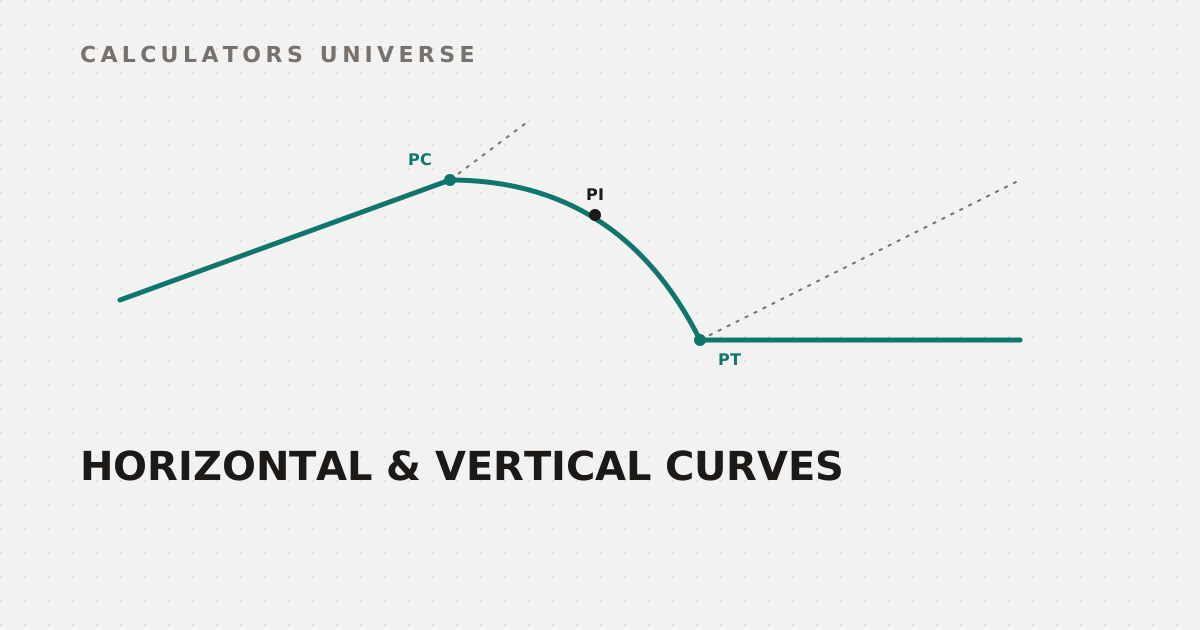
A horizontal curve replaces a sharp corner between two straight road sections (tangents) with a smooth circular arc. Three points define it:
- PC (Point of Curvature) — where the straight tangent ends and the circular curve begins
- PI (Point of Intersection) — where the two tangent lines would have met if extended
- PT (Point of Tangency) — where the curve ends and the next straight tangent begins
The circular arc between PC and PT replaces what would otherwise be a sharp corner at PI
The core formulas: tangent length T = R × tan(Δ/2) and curve length L = 2πR × (Δ/360°), where R is the curve’s radius and Δ is the deflection angle between the two tangents. Both PC and PT sit exactly distance T from PI along their respective tangents. Work out the full set — tangent, curve length, chord, external distance, and superelevation check — from either design speed or radius directly with the Horizontal Curve Calculator.
Vertical Curves: Smoothing Grade Changes
Where horizontal curves smooth direction changes, vertical curves smooth grade changes — a parabolic curve connecting an approach grade to a departure grade instead of meeting at a sharp break in slope. A crest curve is convex (like cresting a hill); a sag curve is concave (like the bottom of a dip).
Both curve types are sized using the same K-value formula, but for different sight distance reasons
Every vertical curve is sized using K = L / A, where L is the curve length and A is the algebraic difference between the approach and departure grades (in percent). K represents the horizontal distance needed for a 1% change in grade — a single number that expresses how abrupt or gentle the grade transition is. Crest curves are governed by daytime stopping sight distance (using a standard 3.5-foot driver eye height and 2.0-foot object height); sag curves are governed by nighttime headlight sight distance instead, since there’s no equivalent “line of sight over the hill” problem in a dip. Get the required curve length, K-value, and sight distance check directly from the Vertical Curve Calculator, or solve for K-value alone with the K-Value Calculator for Sag & Crest Curves.
Superelevation: Banking the Curve So You Don’t Slide
A vehicle on a horizontal curve needs enough combined banking and tire friction to counteract the centrifugal force pulling it outward. AASHTO expresses this as e + f = V² / 127R (metric: V in km/h, R in meters) or equivalently R = V² / [15 × (e + f)] in US customary units (V in mph, R in feet) — where e is the superelevation rate (the cross-slope, typically capped around 0.06–0.10 for highways) and f is the side-friction factor available at that speed. Higher design speed or a tighter radius demands more superelevation, friction, or both. Calculate the required rate, transition length, and stationing with the Superelevation Calculator.
Spiral Transition Curves: The Missing Piece
A vehicle entering a circular curve directly from a straight tangent experiences an instantaneous jump in lateral acceleration — uncomfortable and, at higher speeds, genuinely unsafe. A spiral (clothoid/Euler) transition curve solves this by inserting a curve whose curvature increases linearly with distance, ramping smoothly from zero (the straight tangent) up to the full circular curve’s curvature — and superelevation can be introduced gradually across that same length instead of applying all at once. Compute the shift, tangent length, and coordinate geometry for a spiral transition with the Spiral / Clothoid Transition Curve Calculator.
Road Grade: The Simplest Number With the Biggest Safety Implications
Underneath all of this sits the plainest calculation of all — grade = rise / run, expressed as a percentage. It’s simple, but it drives real constraints: AASHTO maximum grade limits by road classification, ADA accessibility thresholds for pedestrian routes, and meaningfully different truck performance on sustained grades. Check grade percentage, angle, ratio, and compliance directly with the Road Grade Calculator.
Frequently Asked Questions
What do PC, PI, and PT mean in road design?
They’re the three defining points of a horizontal curve: PC is where the curve begins (leaving the tangent), PI is where the two straight tangents would have intersected, and PT is where the curve ends (rejoining the next tangent).
What does a vertical curve’s K-value actually represent?
K is the horizontal distance, in the curve’s length units, over which the grade changes by 1%. A larger K means a longer, gentler curve for the same grade change.
Why do crest and sag curves use different sight distance rules?
Crest curves are limited by how far ahead a driver can see over the top of the hill in daylight. Sag curves have no equivalent obstruction, so they’re instead limited by how far a headlight beam reaches at night.
Why does a curve need superelevation instead of just relying on tire friction?
At highway speeds, tire friction alone often can’t fully counteract the centrifugal force on a curve of practical radius — banking the roadway (superelevation) shares that load, allowing tighter, safer curves at the design speed.
Why not just connect a tangent directly to a circular curve?
Doing so creates an instantaneous jump in lateral acceleration and curvature right at the PC, which is uncomfortable and can be unsafe at higher speeds — a spiral transition curve ramps that change in gradually instead.
Related Calculators
Design the turn itself with the Horizontal Curve Calculator and Spiral Transition Curve Calculator, bank it correctly with the Superelevation Calculator, and handle the vertical profile with the Vertical Curve Calculator and K-Value Calculator for Sag & Crest Curves. Check the underlying slope at any point with the Road Grade Calculator.
External Resources
- Road curve — Wikipedia — overview of horizontal and vertical curve types in highway design
- AASHTO Green Book — Federal Highway Administration — official reference for the geometric design standards behind these formulas