Haversine vs Vincenty vs Great-Circle: How Accurate Is Your Distance Calculation?
Haversine assumes a perfect sphere; Vincenty models Earth's real ellipsoid — and has a documented failure case for nearly antipodal points. Here's the real math.
Haversine vs Vincenty: How Accurate Is Your Distance Calculation, Really?
“Great-circle distance” gets used as a blanket term, but the formula behind it matters more than most calculators let on. Haversine and Vincenty solve the same basic problem — distance between two points on Earth — using two fundamentally different models of Earth’s shape, and one of them has a real, documented failure case worth knowing about before you rely on it.
The Haversine Formula: Fast, Simple, Sphere-Based
Haversine treats Earth as a perfect sphere with a fixed mean radius (about 6,371 km), then applies straightforward spherical trigonometry to find the shortest arc between two points. It’s fast, numerically stable, and easy to implement — which is exactly why it’s the default behind most “distance to nearest store” features and everyday mapping tools.
The catch is Earth’s actual shape: it’s an oblate spheroid, bulging at the equator and flattened at the poles, with roughly a 21.3 km difference between its equatorial radius (6,378.1 km) and polar radius (6,356.8 km). Because Haversine ignores that bulge, it can’t be guaranteed accurate to better than about 0.5% in the worst case. For distances under 100 km, that error is negligible in practice — but it doesn’t disappear, it just gets small enough to ignore.
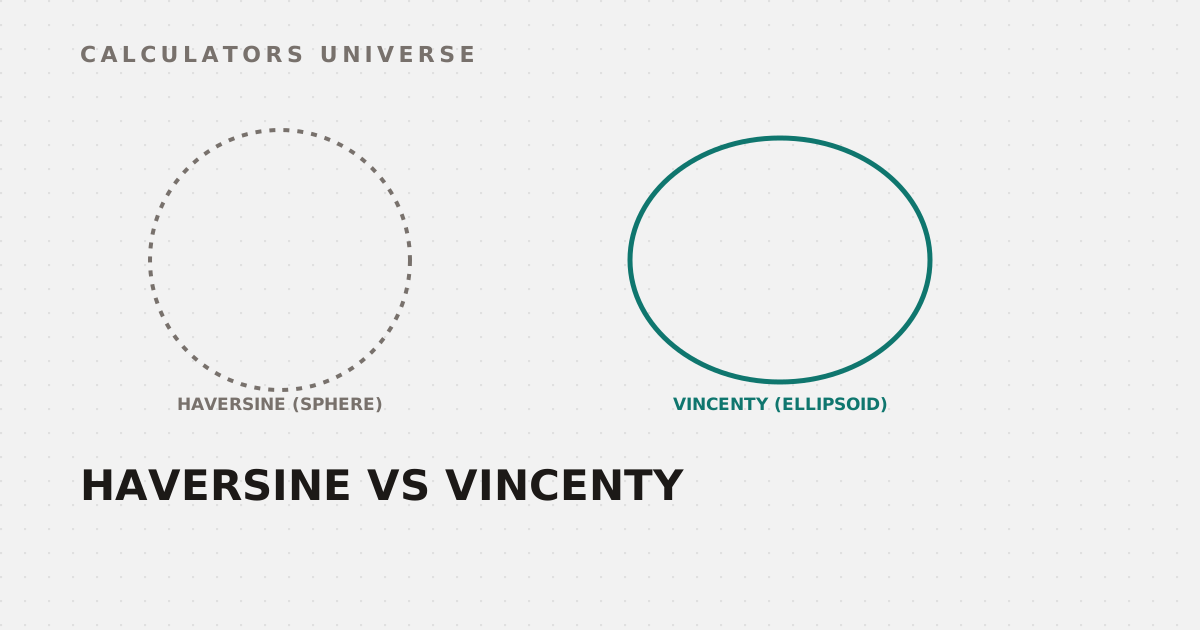
Exaggerated for visibility — Earth's real equatorial bulge is about 21.3km, roughly 0.3% of its radius
Calculate this directly with the Haversine Distance Calculator, which returns distance in kilometers, miles, and nautical miles.
Vincenty’s Formulae: Ellipsoid-Accurate, But Iterative
Vincenty’s formulae model Earth as the actual WGS84 ellipsoid rather than a sphere, solving iteratively for the geodesic distance between two points. The payoff is real: accuracy down to roughly 0.5 millimeters on the reference ellipsoid, dramatically better than Haversine’s ~0.5% ceiling. That’s why aviation, precision surveying, and geodesy default to Vincenty (or a modern refinement of it) instead of a spherical formula.
The cost is that it’s iterative, and it has a genuine, documented weak point: nearly antipodal points (locations on almost exactly opposite sides of the Earth). A cited example — from (0°, 0°) to (0.5°, 179.5°) — takes roughly 130 iterations to reach 1mm accuracy, and in more extreme near-antipodal cases the iteration can fail to converge at all. This isn’t a rare theoretical edge case either — it’s specifically the geometry the Antipode Calculator is built around, which is why production systems using Vincenty need a fallback plan for it.
Charles Karney's later algorithm fixes this — it always converges, with nanometer-level accuracy
Practical Guidance: Which Should You Actually Use?
| Use Case | Recommended Formula | Why |
|---|---|---|
| App “distance to nearest X” | Haversine | Fast, simple, error is negligible at regional scale |
| Aviation, surveying, precision logistics | Vincenty | Ellipsoid-accurate to sub-millimeter level |
| Routes near-antipodal (rare, but real) | Karney’s method (or Vincenty with a fallback) | Vincenty’s iteration can stall or fail exactly here |
| Short distances under ~100km | Either | Both agree closely at this scale — the sphere/ellipsoid gap barely matters |
The Distance & Bearing Calculator supports both Haversine and Vincenty directly (with CSV batch upload for multiple coordinate pairs), so you can compare the two on your own data rather than take either formula’s accuracy on faith.
Building the Full Navigation Picture
Distance alone rarely answers the whole question — most real route planning also needs bearing, a midpoint, or a projected destination:
- Find the exact halfway point along a route with the Great Circle Midpoint Calculator.
- Project a destination coordinate from a starting point, bearing, and distance with the Destination Point Calculator.
- Convert between quadrant bearings and whole-circle azimuths with the Bearing to Azimuth Converter.
- Find the exact point on the opposite side of the Earth — the case where Vincenty’s convergence problem actually shows up — with the Antipode Calculator.
Frequently Asked Questions
Is Vincenty always more accurate than Haversine?
Yes, in terms of matching Earth’s real ellipsoidal shape — but “more accurate” only matters if your use case needs sub-meter precision. For most everyday distance queries, Haversine’s error is too small to notice.
Why does Vincenty’s formula sometimes fail?
Its iterative solution can converge very slowly, or fail entirely, for nearly antipodal point pairs — a documented limitation tied to the geometry of the ellipsoid near those extreme cases.
Should I always use Vincenty just to be safe?
Not necessarily — it’s slower to compute and has a real failure mode Haversine doesn’t share. For regional distances, Haversine is simpler, faster, and accurate enough; Vincenty earns its complexity at precision-critical or long-distance scales.
Does the choice of formula matter for short distances?
Barely. Under roughly 100km, the sphere-vs-ellipsoid gap that causes Haversine’s error is small enough that both formulas will agree closely.
What does “great-circle distance” actually mean?
Technically, it refers to the shortest path between two points on a sphere (what Haversine and the spherical law of cosines compute). Vincenty solves the related but distinct “geodesic” problem on an ellipsoid, which isn’t a true circle — the terms get used loosely, but they describe different models.
Related Calculators
Start with the Haversine Distance Calculator or the Distance & Bearing Calculator (which supports both formulas plus CSV batch upload), then build out a full route with the Great Circle Midpoint Calculator, Destination Point Calculator, and Bearing to Azimuth Converter. Check Vincenty’s known edge case directly with the Antipode Calculator.
External Resources
- Haversine formula — Wikipedia — background on the spherical distance formula and its error characteristics
- Vincenty’s formulae — Wikipedia — full technical reference, including the antipodal convergence limitation