Fibonacci Sequence Generator: Where the Textbook Formula Breaks
Binet's closed-form Fibonacci formula matches the exact value through term 70 — then gets term 71 wrong by exactly 1, and term 100 wrong by over 1.2 million. Here's why this generator never uses it.
Fibonacci Sequence Generator: Where the Textbook Formula Breaks
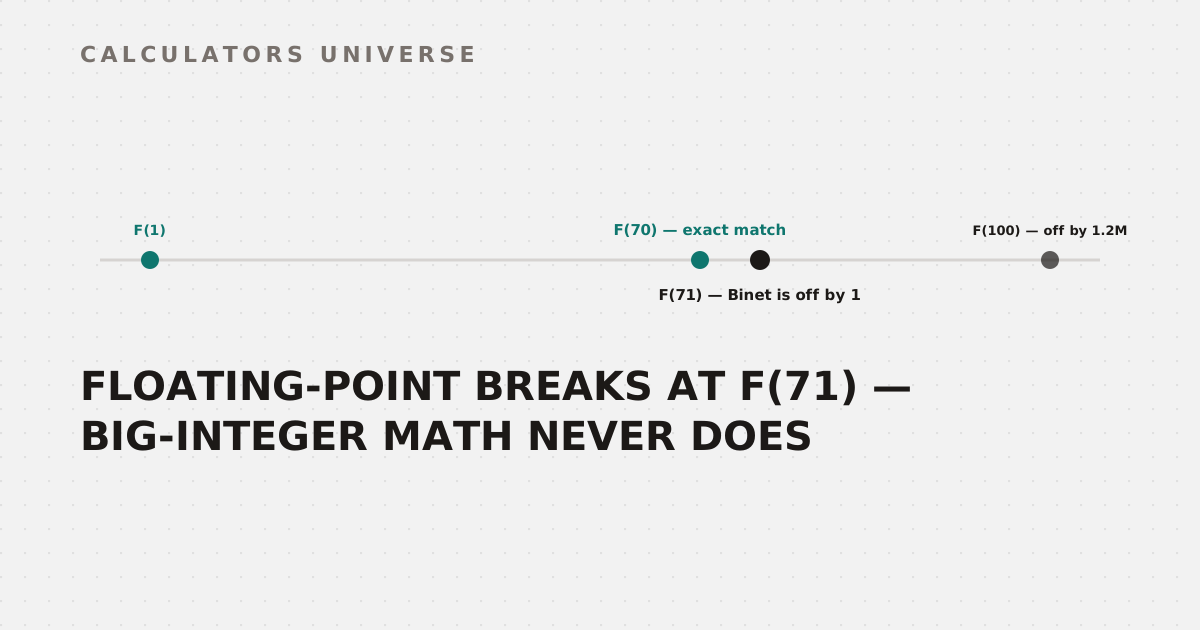
Binet’s closed-form formula — the one taught as the “elegant” way to compute any Fibonacci number directly — gets every single term exactly right through F(70). At F(71), computed in standard double-precision floating point, it’s off by exactly 1. By F(100), the error has grown to 1,196,093 — the formula reports 354,224,848,179,263,111,168 when the real value is 354,224,848,179,261,915,075. The Fibonacci Sequence Generator never uses this formula at all, for exactly this reason. Here’s the arithmetic behind why, and what it uses instead.
Binet’s Formula, and Where It Actually Fails
Binet’s formula computes the nth Fibonacci number directly from the Golden Ratio:
F(n) = (φⁿ − ψⁿ) / √5, where φ = (1+√5)/2 and ψ = (1−√5)/2
It’s mathematically exact — but computing it on a real machine requires representing an irrational number (√5, and therefore φ) in floating point, which is never exact past a fixed number of significant digits. Every term computed this way carries a small rounding error that grows as φⁿ grows. Below F(71), that error stays small enough to round away to the correct integer. At F(71), it doesn’t:
| Term | Exact value | Binet’s formula (float64) | Match? |
|---|---|---|---|
| F(70) | 190,392,490,709,135 | 190,392,490,709,135 | Yes |
| F(71) | 308,061,521,170,129 | 308,061,521,170,130 | No — off by 1 |
| F(90) | 2,880,067,194,370,816,120 | 2,880,067,194,370,824,704 | No — off by 8,584 |
| F(100) | 354,224,848,179,261,915,075 | 354,224,848,179,263,111,168 | No — off by 1,196,093 |
The error doesn’t stay small — it compounds every term, because each step multiplies the accumulated floating-point rounding error by φ again.
What This Generator Computes Instead
Rather than the closed-form formula, this tool computes every term the slow, boring, exact way: starting from F(0)=0 and F(1)=1, each next term is the sum of the previous two, using Go’s math/big.Int — an arbitrary-precision integer type with no fixed bit width and therefore no rounding error, ever:
a, b := 0, 1
for each step:
    next := a + b
    a, b = b, next
Every term produced this way is exact, whether it’s the 10th term or the 2,000th. There’s no floating-point step anywhere in the calculation — just repeated big-integer addition.
How Fast the Numbers Actually Grow
The number of digits in F(n) grows at a fixed, predictable rate: log₁₀(φ) ≈ 0.209 digits per index. That’s not an approximation for this post — it’s the exact constant this tool’s own source comments cite for capping input sizes:
| Term | Digits |
|---|---|
| F(100) | 21 |
| F(500) | 105 |
| F(1,000) | 209 |
| F(1,500) | 314 |
| F(2,000) | 418 |
F(2,000) works out to exactly 418 digits — 2,000 × 0.209 ≈ 418, matching the growth rate precisely. That’s also why the generator caps both the term count and the starting offset at 2,000 each: since the loop runs offset + count times, a maxed-out request computes toward F(4,000), a number with roughly 836 digits, entirely within one web request. Raise that cap significantly and the same request could be made to compute numbers with tens of thousands of digits, turning a simple sequence request into a genuine CPU and memory cost on the server.
Computing the Golden Ratio Convergence Without Losing Precision
The generator also reports how closely the ratio of its last two terms approaches the Golden Ratio (φ ≈ 1.618034) as the sequence grows. Naively, you’d convert both big integers to float64 and divide — but that reintroduces exactly the precision loss this whole tool exists to avoid for the terms themselves. Instead, it parses both term strings into arbitrary-precision big.Float values and performs the division at that precision first, only converting the final ratio down to a display-friendly float64 at the very last step. The terms stay exact throughout the entire pipeline; only the final convergence ratio — a value that’s approximate by definition once you want a single decimal number out of it — takes on any floating-point behavior at all.
How to Use the Fibonacci Sequence Generator
- Open the Fibonacci Sequence Generator.
- Set how many terms you want (up to 2,000) and a starting offset if you don’t need the sequence from F(0).
- Read the exact generated terms, the digit count of the final term, and how close the last ratio sits to the Golden Ratio.
- For a specific term far out in the sequence, remember total digits scale at roughly 0.209 per index — a rough way to sanity-check how large a result you should expect before generating it.
Related Calculators
For exact arithmetic on numbers with up to 10,000 digits directly, use the Big Number Calculator — the same arbitrary-precision approach that powers this generator’s term calculations. Compare linear and exponential growth patterns with the Arithmetic Sequence Calculator and Geometric Sequence Calculator, identify an unknown sequence type automatically with the Number Pattern & Sequence Finder, sum a run of terms with the Summation Calculator, and apply exponential growth to a real-world doubling question with the Doubling Time Calculator.
Frequently Asked Questions
Why not just use Binet’s formula — isn’t it faster?
It’s faster to write, but it’s only exact up to F(70) when computed in standard double-precision floating point, after which accumulated rounding error in representing √5 causes it to return the wrong integer. For a tool that promises exact Fibonacci values at any size, an O(n) loop using arbitrary-precision integers is the only approach that stays correct past that point.
Could Binet’s formula be fixed with higher floating-point precision?
In principle, yes — using an arbitrary-precision floating-point library for φ and √5 could push the breaking point much further out, but at that point you’re doing the same kind of arbitrary-precision arithmetic this tool already uses for the direct iterative approach, just with extra steps and a new source of implementation complexity. The iterative big-integer method sidesteps the whole problem by never touching an irrational number in the first place.
Why does the generator cap terms and offset at 2,000 each?
Because the number of digits in a Fibonacci term grows at a fixed rate of about 0.209 digits per index, and the loop computes offset+count terms internally regardless of which ones you actually asked to see. A maxed-out request already approaches a term with roughly 836 digits; removing the cap would let a single request force the server to compute numbers with tens of thousands of digits, which costs real CPU and memory for a result almost no practical use case actually needs.
Does the Golden Ratio convergence value lose precision the way Binet’s formula does?
The terms feeding into it don’t — they’re parsed from the exact big-integer strings into arbitrary-precision floats before the division happens, so the ratio itself is computed at high precision. The only rounding that happens is the final, unavoidable step of expressing that ratio as an ordinary decimal number for display, which is a display concern rather than a computation error.
How many digits will the 500th Fibonacci term have?
Roughly 105 — multiply the term index by approximately 0.209 (log₁₀ of the Golden Ratio) to estimate the digit count of any Fibonacci term before generating it, which is useful for sanity-checking how large a result to expect from a given input.
The “elegant” closed-form formula and the “boring” iterative loop compute the same mathematical sequence, but only one of them is still telling the truth once you ask it for term 71.
External Resources
- Fibonacci sequence — Wikipedia — covers Binet’s formula and its closed-form derivation in full
- Go math/big package documentation — official documentation for the arbitrary-precision integer and float types used in this generator