Compound Interest vs Simple Interest: The Real Math Behind How Money Actually Grows
Same principal, same rate — wildly different outcomes. The real formulas behind simple and compound interest, and why compounding frequency matters.
Compound Interest vs Simple Interest: How Money Actually Grows
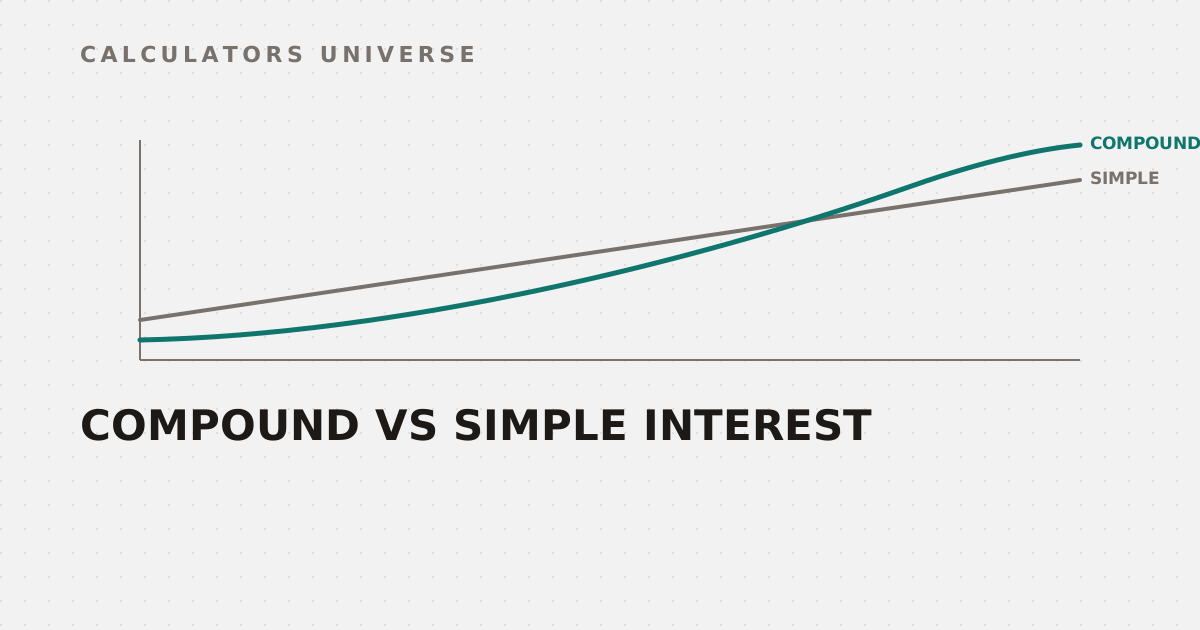
Same starting amount, same interest rate, same number of years — and yet simple and compound interest produce dramatically different results. The entire gap comes down to one question: does interest earn interest, or not?
Simple Interest: Linear Growth
Simple interest is calculated only on the original principal, every period, for the life of the investment or loan: A = P(1 + rt), where P is principal, r is the annual rate, and t is time in years. Interest earned in year one doesn’t itself earn anything in year two — growth is a straight line. Compare simple and compound growth on the same numbers side by side with the Simple vs Compound Interest Calculator.
Compound Interest: Exponential Growth
Compound interest calculates interest on the principal plus all previously accumulated interest: A = P(1 + r/n)ⁿᵗ, where n is the number of compounding periods per year. Because each period’s interest becomes part of the base for the next period, growth compounds exponentially rather than linearly — and the longer the time horizon, the more dramatic the gap between the two becomes.
Same principal, same rate, same time — the gap between straight-line and exponential growth widens every year
See full future value, total interest, and a year-by-year growth table (including monthly contributions) with the Compound Interest Calculator.
Why Compounding Frequency Itself Matters
Two accounts can advertise the identical nominal rate (APR) and still pay out differently depending on how often that interest compounds — monthly, daily, or continuously. The actual return you receive is the Effective Annual Rate (EAR): for discrete compounding, EAR = (1 + r/n)ⁿ − 1; for continuous compounding — the mathematical limit as compounding periods approach infinity — EAR = eʳ − 1. A higher compounding frequency at the same nominal rate always produces a slightly higher effective return. Convert between nominal and effective rates for any compounding frequency with the Effective Annual Rate Calculator.
The Rule of 72 (and 70, and 69.3): Doubling Time Shortcuts
A quick way to estimate how long money takes to double without doing the full exponential math:
| Shortcut | Best For | Why |
|---|---|---|
| Rule of 72 | Rates around 6%–10% | 72 has many convenient divisors, making mental math easy, and is closest to exact in this range |
| Rule of 70 | Lower rates, roughly 2%–5% | Slightly more accurate than 72 at lower rates while still easy to divide |
| Rule of 69.3 | Continuous compounding | Mathematically exact for continuous compounding, since ln(2) ≈ 0.693 |
For most everyday rates, all three land close enough together to be useful estimates. Get the exact doubling time alongside both rule-of-thumb approximations with the Doubling Time Calculator.
Applying This to Real Debt: Mortgages
Compound interest doesn’t just work for you as a saver — it works against you as a borrower. A fixed-rate mortgage payment is calculated from the amortization formula M = P × r(1 + r)ⁿ / [(1 + r)ⁿ − 1], where r is the monthly interest rate and n is the total number of payments. Because interest accrues on the remaining balance each month, early payments are weighted heavily toward interest rather than principal — the same compounding math that grows an investment also front-loads a loan’s interest cost. See your monthly payment and full amortization schedule with the Mortgage Calculator.
Measuring the Result: ROI and CAGR
Once growth has actually happened, the way to judge whether it was a good outcome — accounting for how long your money was invested — is ROI% and its annualized form, CAGR (Compound Annual Growth Rate). Calculate ROI, CAGR, return multiple, and break-even period for any investment with the ROI Calculator.
Frequently Asked Questions
What’s the real difference between simple and compound interest?
Simple interest is calculated only on the original principal every period; compound interest is calculated on the principal plus all previously earned interest, which is why compound growth accelerates over time while simple growth stays linear.
Why does compounding frequency matter if the nominal rate is the same?
Because more frequent compounding lets interest start earning interest sooner within the same year — daily compounding produces a slightly higher effective annual rate than monthly compounding at the identical nominal rate.
Is the Rule of 72 always accurate?
It’s most accurate for rates roughly between 6% and 10%; for lower rates, the Rule of 70 (or the mathematically exact Rule of 69.3 for continuous compounding) gives a closer estimate.
Why do mortgage payments feel front-loaded with interest?
Because interest is calculated on the outstanding balance each month, and that balance is largest at the start of the loan — as the balance shrinks over time, a growing share of each fixed payment goes toward principal instead.
What’s the difference between APR and EAR?
APR (the nominal rate) doesn’t account for compounding frequency within the year; EAR (Effective Annual Rate) does, which is why two accounts with the same advertised APR can pay out different actual returns depending on how often they compound.
Related Calculators
Compare growth types directly with the Simple vs Compound Interest Calculator and see full year-by-year projections with the Compound Interest Calculator. Convert nominal to effective rates with the Effective Annual Rate Calculator, estimate doubling time with the Doubling Time Calculator, apply the same math to debt with the Mortgage Calculator, and measure real-world outcomes with the ROI Calculator.
External Resources
- Rule of 72 — Wikipedia — background and accuracy range of the doubling-time approximation
- Investor.gov — Compound Interest Calculator — official U.S. SEC investor education resource