Binary, Hex, and ASCII Explained: How Computers Actually Store a Letter
The letter 'A' is just the number 65 underneath. UTF-8, the encoding behind 98.9% of websites, was sketched on a diner placemat in 1992. Here's the real chain.
Binary, Hex, and ASCII Explained: How Computers Store a Letter
The letter “A” you’re reading right now isn’t stored as a letter at all — underneath, it’s just the number 65. How that specific mapping came to be standardized, and how it quietly evolved to support every written language on Earth, traces back through a 1963 committee standard and a 1992 diner placemat sketch.
ASCII: The Original Agreement
ASCII (American Standard Code for Information Interchange) assigns every English letter, digit, and punctuation mark a specific number from 0 to 127 — fitting entirely within 7 bits. Work began in 1960 under the American Standards Association’s X3.2 subcommittee, led by Robert W. Bemer, and the standard was formally published in 1963. Its 128 codes split into 33 non-printing control characters (inherited from earlier telegraph and teleprinter codes) and 95 printable characters covering the alphabet, digits, and punctuation. Look up any character’s decimal, hex, octal, and binary value — plus its HTML entity and escape codes — with the ASCII Table & Character Lookup.
From Letter to Number to Binary to Hex
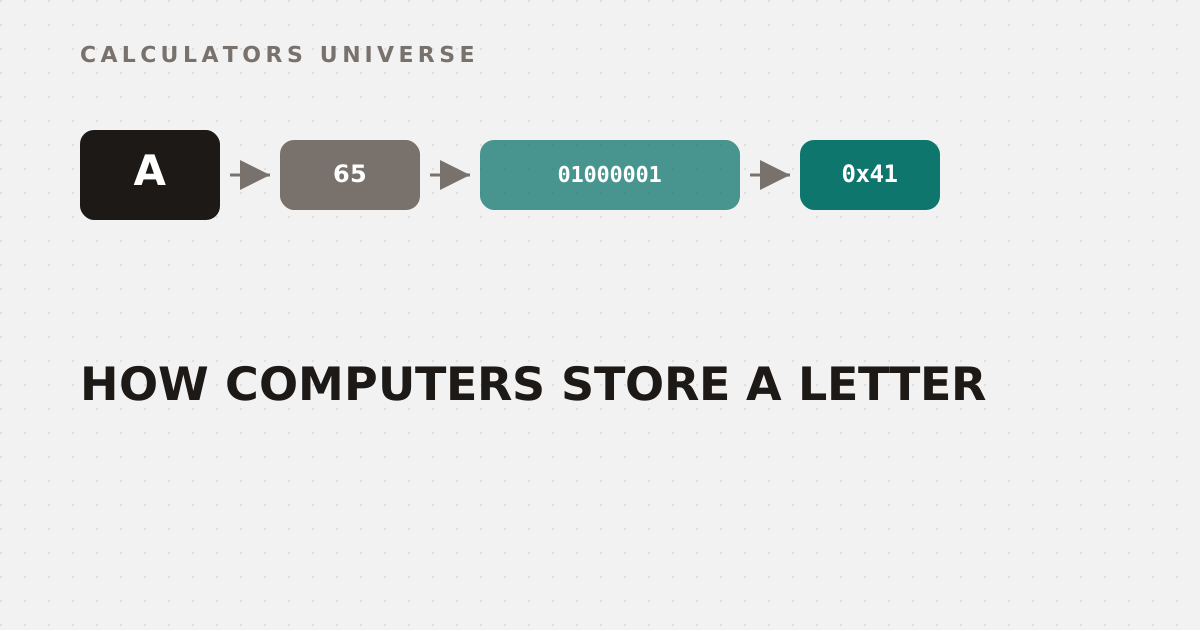
The letter “A” is ASCII code 65. That same value, in the different number systems computers actually operate in, is 01000001 in binary and 0x41 in hexadecimal — three different notations for the exact same underlying quantity.
Same value, three notations — none of them is more "real" than the others
Convert between any of these representations, with a full place-value breakdown, using the Decimal to Binary Converter, Binary to Decimal Converter, and Hex to Decimal Converter.
Beyond 128: Extended ASCII’s Mess, and UTF-8’s Fix
Standard ASCII only covers 128 characters — nowhere near enough for accented letters, non-Latin scripts, or symbols. The stopgap, “extended ASCII,” used the 8th bit to add 128 more codes, but different vendors and regions filled that extra space with incompatible characters, producing a genuinely fragmented mess of mutually unreadable encodings throughout the 1980s and 90s.
UTF-8 fixed this, and its origin story is oddly specific: Ken Thompson sketched its core design on a diner placemat in New Jersey on September 2, 1992, working with Rob Pike at Bell Labs, building on an earlier proposal by Dave Prosser. The elegant part of the design: UTF-8’s first 128 code points map identically to classic ASCII, encoded as single bytes with the same binary values — meaning any plain ASCII file is already valid UTF-8 with zero conversion needed. Beyond that, UTF-8 uses a variable-length scheme — 2 bytes for the next ~1,920 code points (covering Latin, Greek, Cyrillic, Hebrew, Arabic, and more), 3 bytes for the rest of the Basic Multilingual Plane (including most Chinese, Japanese, and Korean characters), and 4 bytes for everything else (including emoji). The result has become the internet’s default: as of January 2026, 98.9% of surveyed websites use UTF-8. Convert binary directly to readable text — with support for 7-bit ASCII, extended ASCII, and UTF-8 — using the Binary to Text Converter.
Working With Raw Bits: Bitwise Operations
Once data is in binary, entire categories of computing — graphics, permissions systems, and cryptography among them — operate directly on individual bits using AND, OR, XOR, NOT, and bit shifts. Calculate any bitwise operation, with binary, decimal, hex, octal, and signed two’s-complement output, using the Bitwise Operations Calculator.
Frequently Asked Questions
Why is the letter “A” specifically the number 65?
It’s simply the value the 1963 ASCII standard assigned to it — an arbitrary but now universally agreed-upon mapping, chosen partly so that uppercase and lowercase letters, and digits, would fall into clean, easy-to-compute numeric ranges.
What’s the difference between ASCII and UTF-8?
ASCII covers only 128 characters in a fixed 7 bits; UTF-8 is a variable-length encoding that supports the entire range of Unicode characters while remaining fully backward compatible with ASCII for the first 128 code points.
Why does UTF-8 use variable-length encoding instead of a fixed size?
To stay compact for common Latin-script text (1 byte per character, same as ASCII) while still being able to represent the full range of world scripts and symbols using more bytes only when actually needed.
Who actually invented UTF-8?
Ken Thompson designed its core scheme in September 1992, reportedly sketched on a diner placemat with Rob Pike, building on an earlier proposal by Dave Prosser at Bell Labs.
Is ASCII still used today?
Yes, effectively as a subset — because UTF-8 was deliberately designed to be identical to ASCII for its first 128 characters, virtually all English-language plain text is simultaneously valid ASCII and valid UTF-8.
Related Calculators
Look up any character with the ASCII Table & Character Lookup, convert between number systems with the Decimal to Binary Converter, Binary to Decimal Converter, and Hex to Decimal Converter, decode raw binary into readable text with the Binary to Text Converter, and work directly with bits using the Bitwise Operations Calculator.
External Resources
- ASCII — Wikipedia — full history of the 1963 standard and its structure
- UTF-8 — Wikipedia — design history, including the 1992 origin story and technical structure